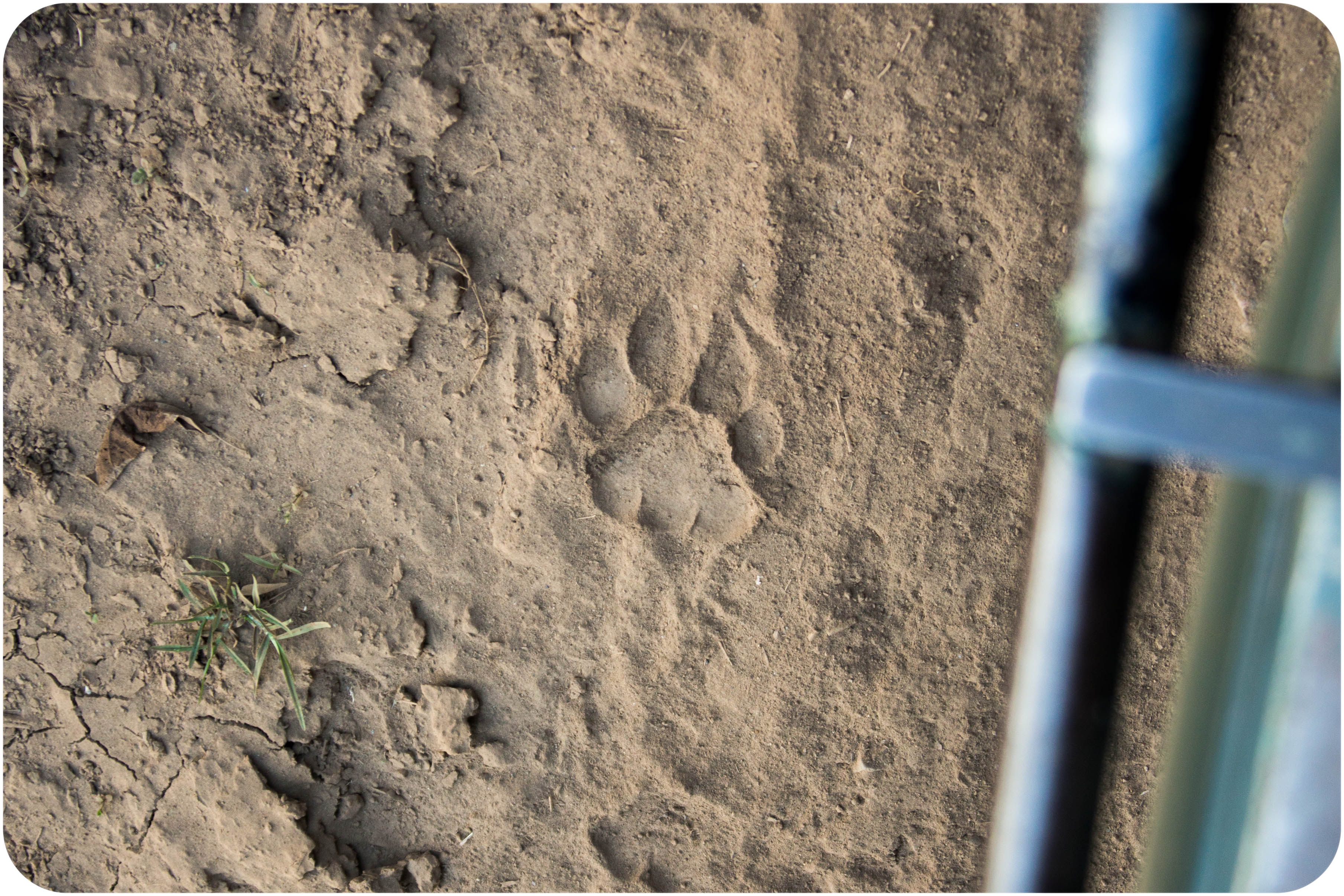
When tracking tigers, the main clues are poo, paw prints, and the communication between other animals. I don’t have any pictures of tiger poo (a bit of decorum please!) but here is a fresh tiger paw print.  Unfortunately, it didn’t lead us to a tiger.
We did not find that print in our backyard, as the only feral animals here are normal cats. We went on a mini safari in the Nagarhole Reserve. It’s pronounced Nagar-holay, not Nagar-hole.  It was one of the best trips we have taken so far.

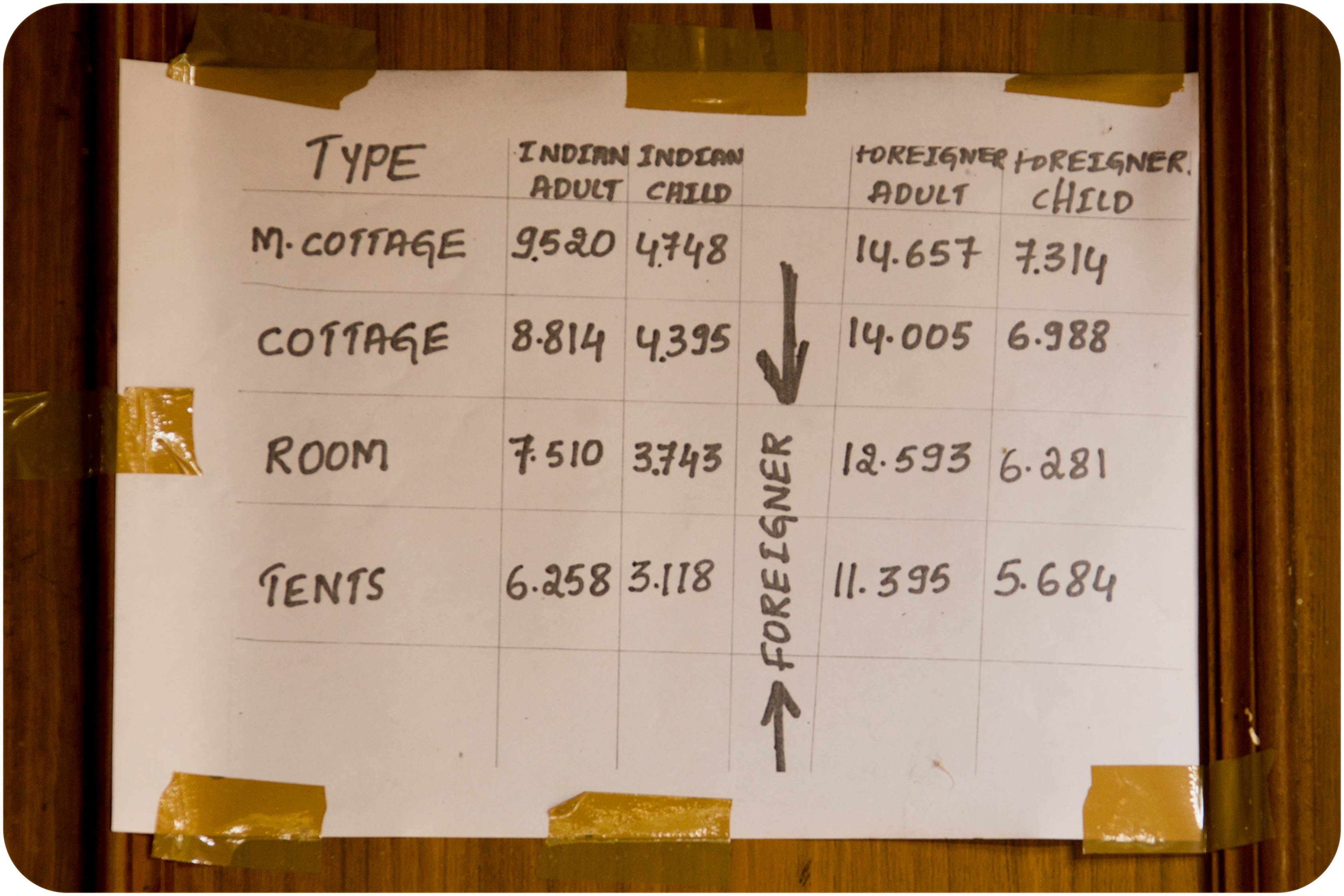
The park is a 6-hour drive from home. We opted for a two-night stay at the Kabini Jungle Lodges and Resorts, and were as usual charged foreigner prices. This legal discrimination in pricing is getting old. I know, bla bla, we have more money, but still…
kabini-2

In a 48-hour span, we went on 4 mini safaris, three on land, one on a boat, about 3 hours each. Two started at 6:15 in the morning. We broke into fits of laughter when they announced a 5:45 wake up call, which is closer to our bedtime than wake-up time. Even Sathya who had driven us there thought it was really funny.

Here, the wild animals free to roam, it is their home, and you are on their turf. At the Bannerghatta Park that we visited last year, only an hour south of Bangalore, the animals are in captivity, albeit on hundreds of acres, and are fed and cared for if they become sick or are injured.  In Nagarhole, they are truly wild, free, unchained, untagged mostly, barely tallied.  But that literally means that “you eat what you kill” and many animals die at the end of summer when there is no water and little to munch on.  To stay alive, their alternative is to roam through the villages and look for humans as food.  Man-eating tigers are a real threat to the local communities.

The main attraction of the Nagarhole Park are its big cats: tigers, leopards and panthers. We saw one leopard only, but it was well worth the trip.  A leopard in the fog, right after sunrise is unforgettable.

We also saw hundreds of spotted deer, tens of cormorans, 3 mongooses (or is it mongeese?), many langur monkeys, several gaurs (big buffalo like creatures), wild hogs with babies (no Edward, this ain’t Texas, you can’t shoot them!), a couple of sambar deer and a barking deer.  We were told they bark like dogs, though this one took off like a bunny rabbit.

There were thousands of birds, including peacocks, though I cannot name most of them. But I now have a favorite bird, the kingfisher, a tiny little blue thing, just the prettiest bird I had ever seen.

So, how do you track a tiger in a tiger reserve? “Here kitty kitty kitty” gets you nowhere, we tried.  Instead, use your senses, mainly eyesight, and hearing. The guides accompanying us were amazing. Of course they are professionals and do that several times a day over the course of several years, but seeing them at work is amazing. We were riding in a jeep, on dirt paths, often in the fog, and they would stop on a dime, point and say “crested eagle” or whatever creature they had seen. For birds, they recognize the song. For tigers, they listen to the other animals talking to each other. When a big cat is on the ground, monkeys sound an alert, then carried around by deer and birds. Guides can identify if the cat is a tiger or a leopard: as tigers cannot climb trees as fast as leopards, they are less of a threat to monkeys. Therefore, the rallying cries of monkeys are louder and longer when they sense a leopard.   Guides can also tell you in which direction the cat is walking, once again by listening to location of the forest chatter. Once a tiger or leopard is spotted on the ground, animals are on high alert and it’s clearly visible even to untrained visitors like us. First, deer will have their ears up and monkeys will go to the top of the trees.   If the tiger is really close, all sound and movement stops until it leaves, and the forest becomes again one giant cacophony of chirps and grunts.  

Elephants are my second favorite. One mother elephant fake charged our jeep when a younger elephant was too intimidated by us to cross the path. In spite of our guide telling us “Don’t worry, take photo, mock charge”, I felt none too safe.  In the Jeeps, there are no weapons of any kind, even tranquilizers, as shooting at one of these animals carries an automatic life sentence.  However, once every few years, when a tiger has eaten one too many villagers in a short amount of time, the government allows for it to be killed.


And to conclude with a smile, we had a close encounter with a thief, the common bonnet macaque, the ubiquitous wild monkey of South India. Listen carefully and you can hear me chuckle like a goose while he sips our drink under the “Do not feed Monkeys” sign.

Monkey 1- American 0.


Posted on by Kitty Vindaloo | 2 Comments

Yes yes, I met a president of India, the ex President of India more exactly. Ok, I didn’t meet him meet him as in “Hi how are you” but I still got to listen to his 45-minute speech. And I am deeply honored.

This morning I listened to Dr. APJ Abdul Kalam, President of India from 2002 to 2007. Here, the role of the President is rather less than that of the Prime Minister, but he’s a well known international figure. As proof, when I goggled him, I recognized his face. When I told my Indian friends I was going to meet him, they all were in awe. They all agreed he is a great man. When I learned last week that I would see him talk, I downloaded a couple of his books and crammed!

It’s all thanks to my school. In a nutshell, the founder of my school wants to change how science in taught by exposing children to “real life” science. As one of the participants on the videos stated “I am glad I never took science in school or I would never have become a scientist”.  She organized a week long festival for 20 schools in Bangalore of all economic backgrounds, centered on the theme of water, with hands-on applications, such as visiting treatment facilities, reading water bills, experiments in water conservancy and many others they would not disclose yet!

Dr. Kalam is a short man, and old man, with a helmet of silver hair. It sounds cliché but he radiated warmth and respect when the walked into the auditorium (preceded a few minutes before by two old overweight bomb sniffing labradors). He was a scientist, worked on the Indian space program before becoming President and is known to have a very good relationship with children. Unfortunately, I didn’t understand much of the first half of his speech: his accent is not one I am accustomed to, and there was a problem with the mike. But the second part was very entertaining. He engaged an audience of over 200 13-year olds on the topic of science to the point that he went over time. 

The next speakers made me want to go back to school. It’s always a pleasure to see experts talk about their passion, with passion. In this case, they are all “water experts”. They talked about water conservation and I now know for a fact that India has some of the greatest minds in the world, but there is a profound disconnect between those brains and the hands that put their work into practice. One man was describing how water comes into Bangalore, from the cauvery river 100 kms south. It is then treated and transported around town. But 45% of the water never reaches destination and is lost due mainly to leakages in the pipes. When you realize these pipes are being installed and repaired by legions of mainly illiterate people with no education and who make at most 200 rupees a day, you understand the organizational pattern of this country: brilliant minds but inadequate execution. Then add corruption to the mix.

I went with Sathya. I had asked the school principal if he could accompany me, since Dr. Kalam is “his” president, not “mine”. I thought it was only fair. I wasn’t sure he would even accept since there is a clear divide between what driver and drivee can do together (basically nothing). He did, and on the way back, we talked about the environment, about plastic bags, about sewer and lake pollution, and the cows he leaves food for every morning. We talked about article 51-A of the Indian Constitution. Ha! I talk about the Constitution with my driver!

Article 51A in The Constitution Of India 1949

51A. Fundamental duties It shall be the duty of every citizen of India (…)

(g) to protect and improve the natural environment including forests, lakes, rivers and wild life, and to have compassion for living creatures;

(h) to develop the scientific temper, humanism and the spirit of inquiry and reform;

You know what we have in the U.S. Constitution? The right to bear arms. Bang.


Posted on by Kitty Vindaloo | 2 Comments

India is full of festivals and auspicious days and celebrations. Most are religious, or governmental special days. This time of year is the four-day festival of Sankranti. I think. Honestly, I am confused about the name. At school kids wished me “Happy Pongal” and wanted my phone number to call me today, but I see other names thrown around. It’s not the first time I am confused here!

Since January 14, farmers have been celebrating the end of harvest. This weekend, we could see them hurrying to cut down the last bits of rice. Goats were nibbling on the leftovers in the fields. It’s also time to give thanks to the farm animals, especially the bullocks who work in the fields and are so valuable to a village economy. They burn the old farming tools and replace them with new ones, such as the tread-rope used to tie the animals. This means a lot of new colorful ones are displayed in store on the side of the road. After the festivities, farmers will be on “holiday” for 2 months.

This festival is very interesting to outsiders because a lot of activities take place outside, unlike Diwali where most of the celebrations are indoors. By just walking in the streets, you can see a lot of interesting things. Hence my trip this afternoon.

Sathya wanted me to see the decorated cows (and the occasional painted dog, which made him laugh so hard), and village life during the celebrations, the decorated temples, farmers gatherings, so we embarked on a 4-hour trip to Tamil Nadu, our neighboring state. It sounds like a trek but it’s not. The state line is about 30 minutes south of here. A few months back, E. even managed to end up there on one of his soul calming Vespa rides. Sathya and I chatted the all way, talking politics, family feuds, law, philanthropy, and food. There is always a discussion about food! He used to be a tourist guide and still enjoys showing off his country. He also serves as my bodyguard when I get intimidated in a crowd. We drove south, and a bit more south, stopped at a shrine where he showed me idols of police officers, a practice particular to Tamil Nadu (yes yes), drove some more but still couldn’t find anything that looked like a village partying. So he stopped and asked a group of men hanging out under a tree in their dhotis why there wasn’t anything fun happening. Low and behold, the government recently banned bullfighting and tamings of the bull (a good thing from what I hear). Having nothing to do and no bulls to force feed alcohol to as entertainment, the men were bored and passing the day chatting away. We still drove around for a couple of hours, because the countryside is absolutely breathtaking, the weather was wonderful, and the colors so vivid.

Here’s a glimpse of my afternoon, from the back of a little white Honda (click to enlarge and for captions).

Happy Pongal!

Posted on by Kitty Vindaloo | Leave a comment

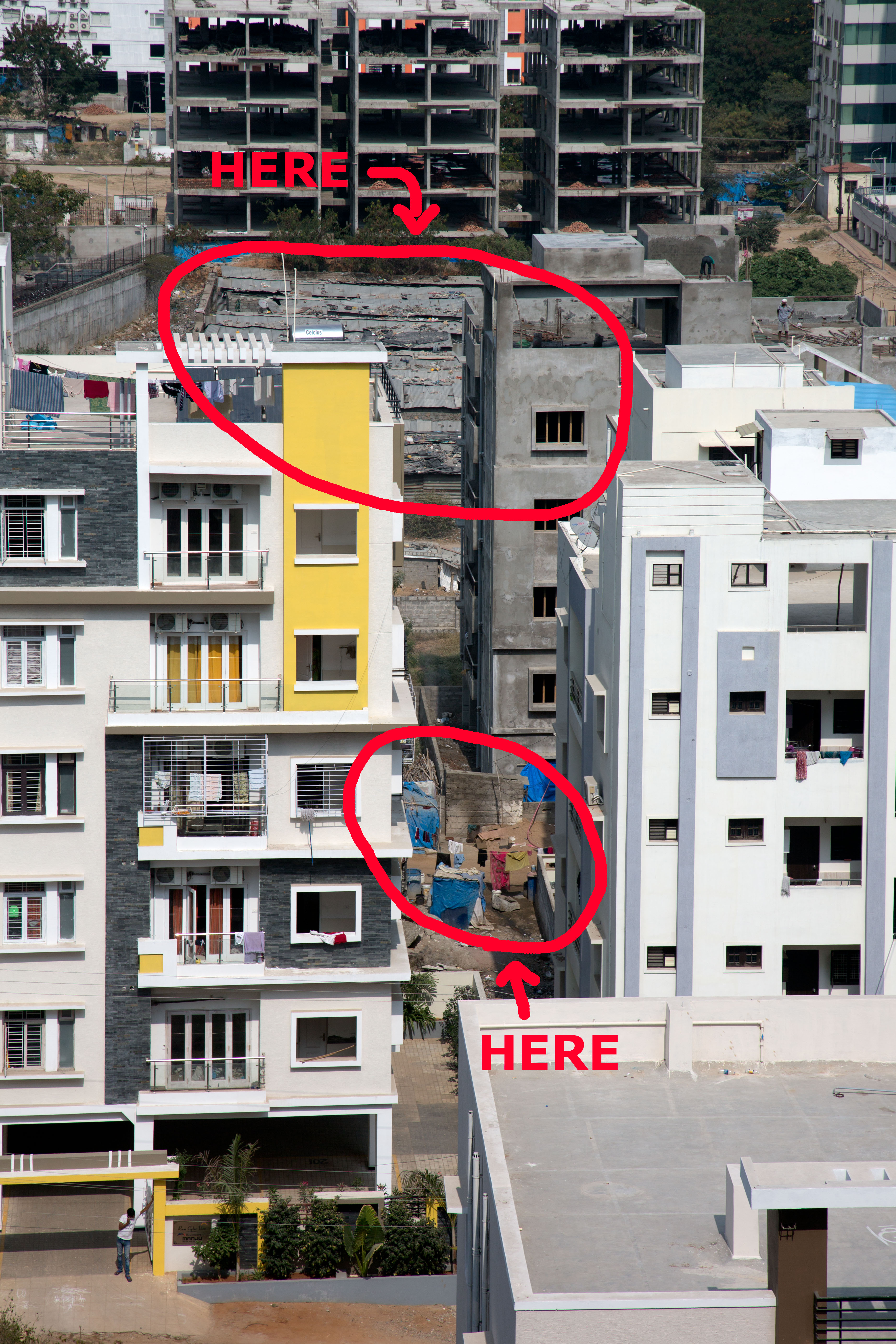
We went back to Hyderabad for a few days, and stayed in the same hotel we did in March 2014. We had a very similar room, with a very similar view (previous post). I thought for a while we actually had the same one, until I noticed there were a few additional “neighborhoods” that I been hidden by buildings last time, and found out we were now one floor above and a few meter to the right.  I could see a migrant camp I had not noticed last year.  However, since the area has really in the last 10 months, another one of the camps is no longer visible from that vantage point.

Camps I had not noticed in March 2014

Again, I spent many hours at the window, camera in one hand, book in the other. We hadn’t brought the “heavy artillery” camera-wise, but I still recognized some of our neighbors. This means that the same people have been living in this “hut” since at least March 2014.  

Once again, I watched their daily lives, the caring for the babies, the cooking, the sweeping, the laundry. I don’t know why there is a demarcation as to where the lady of the house has to stop sweeping, but the debris is always piled up outside and left in the same spots. The frenzied activities I had last seen around lunchtime didn’t happen.  On our second day, I woke up to see tarps covered in red chillies set out to dry.  This is a common sight, even in our ritzy rich compound, but I had never seen so many.  I thought they belonged to the people living in the hut, but late afternoon, the ladies working at the construction site a few feet away came back, gathered them and moved them away (click to enlarge image).

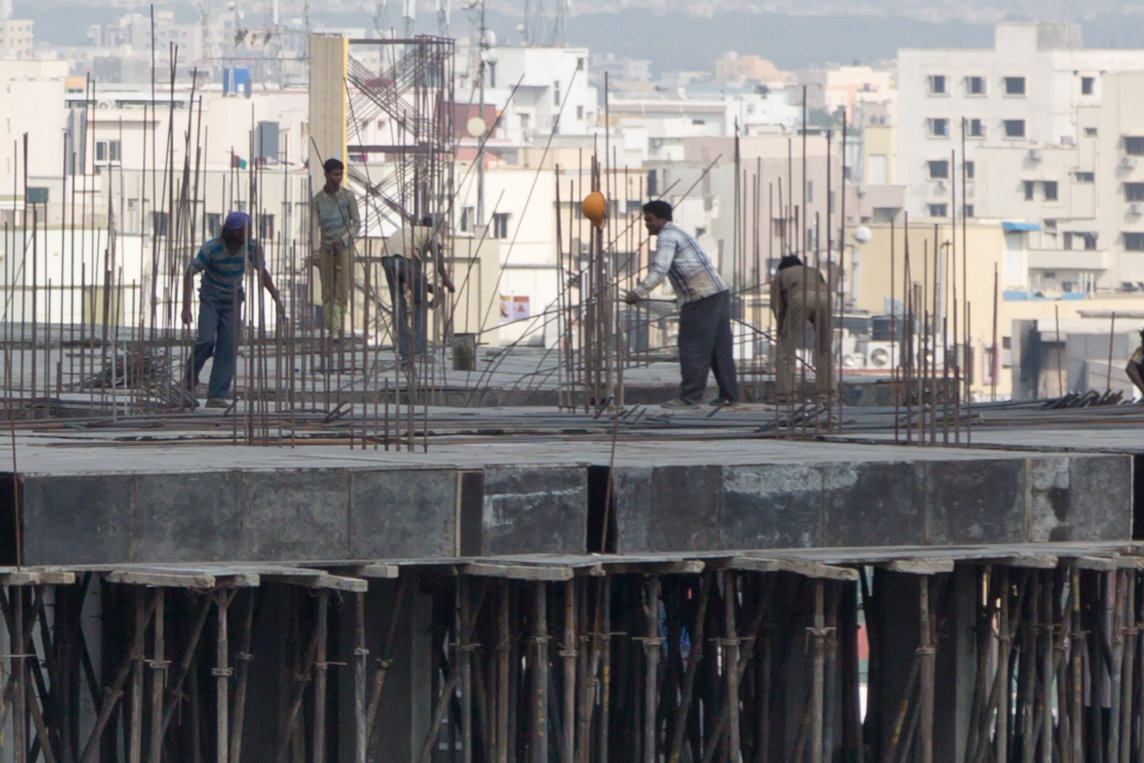
This time I had a much better view and had time to observe the masonry techniques at length. I am appalled. This is not a new feeling.  Anyone who lives in India can attest to the rudimentary (read: non existent) technology (previous post on working conditions). The wheel, one of mankind’s greatest inventions, is nowhere to be found during the construction of building in Cyberabad in 2015. All materials, sand, bricks, rocks, are carried on someone’s head, usually a woman’s. I have not seen one pulley, the good old pulley. Nor have I seen anything resembling a lever. I watched in detail cement pillars being made: plastic boxes used as moulds are laid around metal rebars. Concrete is mixed on the ground, brought up in flat plastic buckets, carried on women’s heads, handed to a man, and poured into the boxes. The bucket is then returned to the woman who goes to refill it and is soon followed by another.

As for safety measures, take a good look at the “escalator” they use: a few rods of bamboo set at an incline. All workers are wearing flip-flops and most don’t wear gloves. Men working at the top of what is currently a 10-story building are not wearing helmets (one is just hanging on a pole), and the safety net leaves much to be desired as it does not protect the entire perimeter.

Coincidently, I have recently since met two people who each own a construction business. I did not have the guts to ask them how much technology they use.

Posted on by Kitty Vindaloo | 2 Comments

Some people you meet make a lasting impact, some random encounters change how you view the world, and how you view yourself, people “sent from above” when you’re having a rough time, to remind you of life’s true value, and values.

In August, I introduced you to the man from Pura, who, believing we were lost, guided us through the streets of his village. Drawn to his charm and warmth, the simplicity of his genuine desire to help strangers, we went back. Twice. And we will go again.

After meeting him and seeing how nice he had been, jogging in front of the scooter, we couldn’t stop talking about this experience. A couple of days later, we enrolled Sathya, his car, his Kannada skills, and Google Maps in our newfound adventure. This time, we went not only armed with water and rice, but a big carton of food. The only clue we had as to where we might find the village again was a screen print of the map we had taken in the area. I am not sure how our dedicated driver felt with his car bopping up and down the dirt roads, in the middle of nowhere, guided only by the trustworthy Google Maps, but 20 kms later, he found the village. I had the man’s picture and he showed it to couple of people standing by the water tower in Pura.  They pointed us towards the green house I had remembered. The gentleman with white hair was sitting on the ground, quietly resting with his back against his house, still wearing a white T-shirt. He was staring at the approaching white car. No car belongs on that side of the village. It is the end of the “road”, ending into the vegetable fields. I could see his eyes gazing in our direction, lost in his thoughts. Then, in a split second, as fast as a scared kitten, he jumped up, smiled and started talking in excitement. He had just recognized E. sitting in the back seat. He was beaming, ecstatic. E. opened the door and found himself engulfed in a warm embrace, as if he had been the long lost cousin returning after years of absence. Sathya and I stayed back and looked at this unexpected and heart-warming scene.

We were invited into his house and met his wife.  Soon we were surrounded by neighbors,  standing in front of the door and never set a foot inside. We had become circus animals, and we were happy with that!

Sathya explained who we are, why we were here, that we had not gotten lost on our previous trip, but were exploring the area. Sitting on the bed-cum-sofa like two potted plants, we got a kick watching the two men talking (about us!) in Kannada and laughing.  We learned his name is Srinivas. I took a couple of pictures, and we promised to come back.

Christmas being the season for giving, I had decided a long time ago that on the 26th of December, we would go back. This time, we didn’t need a print out of the map, or a picture of the man with white hair, Sathya found his way directly to the green house. Srinivas was having a drink of water when he spotted the car, and I thought he was going to choke. The same scene repeated itself. I was ignored for a few minutes while the two buddies hugged and laughed. I had a picture of a young boy I had taken last time and someone went to get him.

We were all again invited into the house, where the wife welcomed us, much less shy that she had been last time. We met Srinivas’ grandson, a cutie pie whom I mistook for a girl because of all the jewelry he was wearing. We met one of his sons and I assume the young woman who stayed in the back room was the daughter-in-law, the mother of the baby boy. We tried to play with him, but he would have none of those strangers hold him! He just stared.  Srinivas disappeared for a few minutes and came back with a bottle of orange soda and some bananas for us. The neighbors were again at the door. Inside, the family had a small business making flower garlands for religious festivals. They had piles of yellow marigolds, some tied up in perfectly round bundles already.

Pura-5

I spend quite a bit of time outside, taking pictures of the children. They now trusted I would come back and give them the prints. They didn’t smile much. My school kids turn into funny lunatics whenever there is a camera pointed at them. The village kids were as serious as an old royal’s portrait. Srinivas wanted pictures with E., with E. and the baby, with E. and his new motorcycle, a recent gift from his children. With me? Nope!  One of the women asked if I wanted flowers for my hair. She made me a small jasmine garland, and a little girl gave me her bobby pin so I could attach it to my braid.  I love my gift.

A gentleman outside was asking Sathya questions about us. Where are they from? Where do they live? What do they eat? Do they believe in God?

Today, they both do.


Posted on by Kitty Vindaloo | 1 Comment

There is no such thing as curry. India is not the land of curry. Curry is not the national dish of India.  You cannot buy a jar of curry powder. There is no curry here.

This is only half true. There is curry, but not what a westerner would expect. If you order a curry dish in a restaurant, you will not get the yellow stew you think about. “Curry” is a generic term for “stew”, or something that has been cooked for a while in a fragrant sauce that you soup up with rice or your choice of bread. The only places where I have seen the yellow curry served is in Thai restaurants, usually along with chicken satay.

There is another curry, the curry leaf. Curry leaves have the shape of bay leaves but are much smaller, maybe 1.5 inches long. Like bay leaves, it is preferable to cook them, or precisely to fry them. I didn’t like them much at first, they almost have a bitter taste, but now I ask Sandra, our cook, to put them in almost anything.

Indian food is not especially pretty to look at.  Most of the time, it looks like a heap of mush, as in a French ratatouille, or the above mentioned stew.  Food photography of Indian cuisine focuses on the accessories: the pretty exotic dish, the patterned tablecloth… and less on what’s in the plate.  If you go by sight only, it’s not appetising.  But the magic starts when you smell it.  Good Indian food has layers of tastes and smells, and degrees of spices.  You need to first smell the dish.  When we first moved here, I sniffed my plate in a restaurant, the waiter laughed and told me I was becoming Indian!  And once you taste it, the flavors should develop and evolve inside your mouth.  It should taste like a rainbow, where you taste all the colors distinctively, yet harmoniously.  This artistry is accomplished by dosing the spices carefully, and it seems that the order in which you add the spices also matters.  Indian food is served twicely hot.  First, it is temperature hot.  They do not like their food lukewarm.  It has to burn your fingers (you eat mostly with your fingers) and mouth. Also, reheating Indian food is simply yuck, as the flavors have then combined into one.  Second, it is spice hot.  And once again, different spices trigger different sensory areas of your mouth.  We have learned that some tickle the tip of your tongue, others the entire tongue, and watch out for heat in your throat!  The worse thing in this case is to drink water, which increases the sensation of heat.  It is recommended to have a spoonful of yogurt or a sip of milk, or better, raita (yogurt with grated carrots, cucumbers and mild spices). I am learning!

You need curry leaves to make sambhar, a South Indian lentil and vegetable soup that E. and I both love, always served as an accompaniment mainly at breakfast. Sambhar is not a curry.  Last Monday, I followed Sandra with my cell phone, pen and paper, and recorded her making some.  She says I am like no other “Madam” she’s worked for.  Instead of sending her for a cooking class at the nearby Italian restaurant (like another expat sent her to), I am asking her to teach me.  Role reversals.  She doesn’t know what to make of it.  To us, her job is less to feed us, and more to teach me so I can attempt to replicate authentic Indian cooking once we go back home.

And for posterity, here’s her recipe:

Cut 3 small tomatoes (about the size of an American big egg), one small (American size) onion into chunks. Put into pressure cooker. Cover well with water.

Add ½ cup toor dal or masoor dal (the latter being “more tasty” she says).  Dal is a generic term for dozens of different “lentils”.

Pressure cook for 3 whistles and take off the heat. Keep the lid closed.

Cut 3 brinjals (small eggplants) into chunks and put in a bowl with water. Don’t skip this step as soaking in water will cut the bitterness. Rinse the brinjal. You can vary the vegetables according to taste. I like to add carrots so I get a little texture in the mix.

Take some water out of the pressure cooker and add to the brinjal bowl.

Mash the dal, tomatoes and onion inside the pressure cooker. Add to the brinjal bowl.

Rinse the pressure cooker.

Heat one tbsp of oil. Add one pinch of mustard seeds and about 10 curry leaves. Fry for one minute.

Add one small onion cut into smaller chunks and cook on high until it turns brown.

Add some of the brinjal + dal mixture and a bit of clean water. Sprinkle one tbsp sambhar powder and stir. I think she forgot to add garam masala. Add the rest of the brinjal/dal mixture. Add a handful of chopped coriander leaves.

Close the pressure cooker. Cook for one whistle.

You will have made enough to feed an entire village.  As no one cooks for two only in India.

Posted on by Kitty Vindaloo | 1 Comment

When I was a little girl, one of my favorite things to do during the weekend was sit curled up next to my mom, reading a book. We would spend hours, each engrossed in our favorite stories. I came to expect that days off were spent reading in silence. That was before the time, when, as a teenager, I would find silence boring and would fill it with music. Later, as a college student, reading for pleasure for hours on end was a luxury, as novels were replaced by studying. Then adulthood set in, I got married, television became omnipresent, and silence nowhere to be heard.

So, this afternoon when I realized there was not a sound to be heard in the neighborhood, I literally put my fingers in my ears to check if I had become deaf. This is India after all, and silence simply does not exist. Does Not Exist.

Let me walk you through a typical day from inside our house.

Every morning, there is the Muslim call to prayer. I had been under the impression that the timing would coincide with sunrise, but once again I was wrong. I still have not found where the closest mosque is, but there is no doubt that the prayer comes from a tape recorder. Unfortunately, it does not have the magnificence it has in Falaknuma in Hyderabad when the songs would rise from several minarets around the hill. The prayers only lasts a few minutes, and don’t disrupt my sleep much. Most days, I don’t hear it anymore.

Every morning at 6:30 am, an old woman in a sari spits right under our bedroom window. I have seen her. It’s not a little cough, as in “I have something stuck in my teeth, let me suck it and spit it out”. It’s the full cleaning of the lung pipes, with great gusto and fanfare. I don’t know if she keeps it just for us, but it’s gross. Disgusting. Repulsive. There are enough empty spaces around, there is no need to spit in my flower beds. At the same time. Every day.

I am usually woken up by construction workers at 7am. Bangalore being Bangalore, apartment buildings are mushrooming everywhere, and one of those buildings is about 200 meters from our front door. The workers bang and hit and sand and scream. Oh! they scream. And they sing too! I believe they bring a little radio and sing along. If I am lucky, I can ignore them and get back to sleep. Otherwise, I wear a set of humongous headphones with white noise that rocks me back to sleep for a few hours.

That is until recently. The house right behind us is being renovated, they are building a canopy over the terrace. It should have been done in a few days, but no, it’s been weeks and from what I can see, it will take a few more. This one is particularly unpleasant since they use a tool that reminds me of  the sound of teeth being drilled. I guess they’re drilling. In concrete blocks, and marble. The headphones are now useless.

Some time between 9am and noon, the garbage carts comes by, or more precisely, is pushed by a team of two, a man and a woman. I can hear them before the ring their hand bell, because they talk so loud. Why is it that when Indian people talk to each other they scream, yet when they talk to me their voice level drops to that of a mouse. A mini mouse (the same happens at my school). The garbage cart lady rings a bell, signifying that you should bring your garbage outside, neatly divided into “dry”, “food”, “bio hazard” and “household dust”. But they don’t pick up bags of kitty poo.

All throughout the day, there are cars and motorcycles that pass in front of our house. Some park in front of us, since more people own cars, yet garages stay the same size. The neighbor in front of us moved out in May, and the house has been vacant since. Not the garage though, it was quickly taken over by another neighbor’s driver. Talking about drivers, another reason why Sathya is the best, is because he knows the trick of switching off the engine instead of letting it run. It is not unusual to hear cars, parked, yet running, while they are being unloaded of shopping bags, or loaded with little rambunctious kids. A running car’s fumes under your window are always a delight.

Drivers are often bored. They usually work set hours, for instance 7 am to 7pm, and spend a great amount of time waiting for “Madam” or “Sir” to need some place to go (we operate under a different system).  They are often on their phones. And they are often loud. Or they hang out together (if “Madam” or “Sir” allows them to walk away from the car) and chat. Loudly.

Let’s not forget the doorbell. We have the loudest doorbell we have ever had in any house we have ever lived in. Everybody and their brother rings our bell. Not a day goes by that we don’t have a stranger at the door. Yesterday, it was the paperboy (who’s about 30 years old) who asked for payment. The day before, a little girl asked if Maggie lives here. Our ex-maid sells us raffle tickets for her church, and rings the bell. Our maid and our cook ring the bell. The DHL guys ring the bell (and yell at you if you were not home when it was convenient for them). The long list of delivery people rings the bell. Sometimes, but not always, the front security office will call us first to make sure we are expecting a delivery. This is supposed to be an ironclad rule, but its application is random. The electrician rings the bell. Today, the plumber (armed with the ubiquitous screw driver) rang the bell.

We are lucky to live next to a young piano prodigy. He’s really good. Once in a while, they have recitals that we get to enjoy without needing an invitation. So he needs to practice. A lot. Like I said, we are lucky he’s good!

That particular family lived in San Jose for several years and still has strong ties in that community. How do I know? Because I hear their phone conversations. There is roughly a 12-hour difference between India and California, so they call their business associates during our evenings, and their school buddies at 3 am. Yes……

Late during the evening, I hear a faint “shhhhh”, which is the sound made by the “mosquito man”. They control mosquito infestations by spraying permethrin on flowerbeds every night, and occasionally they spray the backyards. Yet, people continue to build ponds with stagnant water in their front yards.

This is around the time the above mentioned canopy builders stop their racket. From 7 am until 7 pm with a lunch break. Continuous, never-ending drilling into concrete blocks.

At night, I hear the krritchooo krritchooo of the walkie-talkies, and the krrrssstik krrrssstik of the sentinels on their bicycles. They ride around the property at irregular intervals, looking for riffraff, stray cats, and the occasional stray dog who would have escaped the vigil of the front gate security and dashed onto the compound. Oh the horror! Oh the dogs, how they bark all night! Have you seen “101 Dalmatians”? Their barking is the same, a complete communication system involving at least 5 canines that send messages from one side of the compound to the other. And then, to add fun to my sleepless nights, are the two playful yet untrained Huskies who live close by. Huskies are beautiful creatures. But they sing. Just search YouTube and you’ll have a taste of what we experience 2 to 3 nights a week. AaaaaWoooooWoooooWoooooooaaaaa.

Did you know that birds sing at night? This is a first to me. India has little birds, the size of an American hummingbird, that are as loud as a trumpet! On a bad (for sleep) night, the bird will sit in the tree in front of our house and render the kittens ballistic.

Friday night is party night. We often hear celebrations taking place outside the gates. Music, firecrackers, whistles, sirens, drunk men, you name it, we hear it. If you consider that some people have counted about 140 days of celebration in India, you get a taste of our local nightlife!

But today, there was nothing. Not a doorbell, not a dog, not a drill, not a note. Pure unadulterated silence.

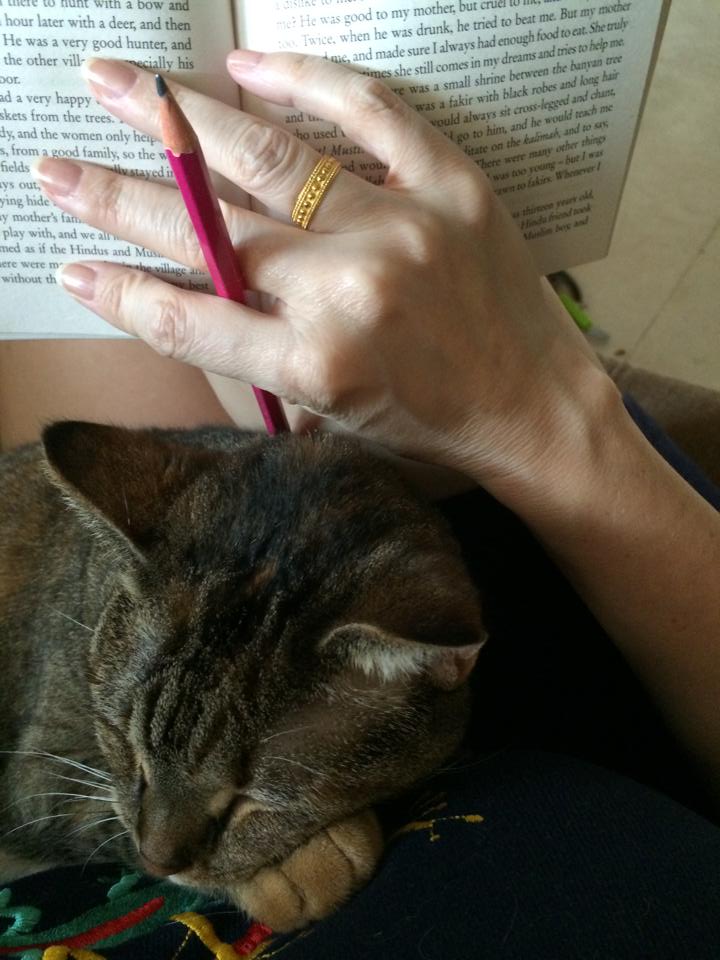
Quietly, “we” read an entire book.

 10419446_10204335947852596_723645751184807554_n

Posted on by Kitty Vindaloo | 6 Comments

A very last minute decision, and we got to see the Taj Mahal on Thanksgiving morning.

Because of his surgery, E. wasn’t supposed to get on a plane for another few weeks (you can follow his brand-new blog at BariatricVindaloo.com). But he got “cleared for take off” and we went to Delhi, he, for a conference, me as the wife-in-tow! Hence, I hadn’t planned the trip. I knew the Taj Mahal was a must, and then, since Delhi is the fashion capital of India, I wanted to go fabric, ribbon and clothes shopping. But germs decided otherwise: I got sick and was only able to venture a few kilometers away from the hotel. I blame myself as I have become complacent with the use of anti-bacterial wipes. I didn’t use one when I came back from the school on Wednesday, nor after the flight, and paid for it with a sore throat and an overall feeling of yuck. What a shame. But we liked Delhi and we’ll be back. 

We met some great people. On the plane from Bangalore, I sat next to a wonderful man whom I started a conversation with. It got so interesting quickly that when the person with the middle seat arrived, I voluntarily surrendered my much coveted aisle seat so I could continue our chitchat! We talked about the U.S., food, Bollywood and religion. Yes, I ventured into the realm of Indian religion!

We also had dinner with an attorney E. works with, with his wife. They both lived in the U.S. for over a decade, and it was fun to listen to their experiences adapting back to the home country. What do they miss most from the States? Fresh air! Air pollution in this city in unbearable. You can see it. I really mean you can see the particles floating in the air. It shows on every picture we took.  And if, like I was, you are sick, you can feel them scratching every inch of your sinuses all the way down to the inside of your lungs. Not only it smells really bad, the simple necessary act of breathing hurts.

We stayed at a fancy hotel again, and for the first time in a long time, I felt seriously underdressed walking into the lobby. My kurta and leggings bought at Big Bazaar, the equivalent of Target, didn’t cut it. It is wedding season, and guests were wearing their best clothes. It was stunning, for women and for men. The embroideries were magnificent. The fabrics themselves were heavy, expertly draped. Since it’s colder up there, women do wear their pashminas. We tried to crash a wedding, but no luck!

Delhi has roads, real roads, well paved, with sidewalks, and without potholes. The more politicians you have in an area, the fewer potholes you suffer. Hence, since Delhi is the nation’s capital, the roads are pretty great. Road congestion was no more than New York during rush hour. The flip side is that we saw more street kids begging than in Bangalore.

Now about the main event: the Taj Mahal. It is located in Agra, a 2 to 3 hour drive south of Delhi. They have built a highway, nicknamed “the Taj Mahal Express”. There isn’t much to see on the way there, some agricultural land and a few workers.  We left at 6 am and I had brought my pillow. Simply trying to walk with my head held high in the hotel lobby while carrying a pillow, surrounded by people still dressed in their best attire even that early in the morning, was an experience! In the car, I was trying to get confortable but my pillow kept slipping. Our driver must have seen it in the review mirror, stopped the car and made me a bed on the far back seat. How sweet is that?

The site is very well organized. You can’t park close so you have a choice of an electric car, or a camel. That early, I was in no mood for a smelly camel! Prices differ for foreigners and Indians: 20 rupees for Indians, 750 for foreigners, a 1/37 ratio. Nothing new here. We paid for two “high value” tickets and got the luxury experience, which means we got to cut lines. We could have done without since it wasn’t crowded but I suspect that on busy days, it would be worth it. And again, lots of people stared at us, took pictures of us, so we took pictures of them!

The Taj Mahal is splendid. It’s beautiful. It’s stunning. But do you think they will revoke my visa if I say I expected more? It was as I had imagined, but I wanted to be blown away. I wanted it to be beyond my expectations. I wanted it to shine and shimmer and blind me with colored sparkles from the semi-precious stones.  In my mind, they were all precious stones, sapphires, rubies and emeralds, when they are mostly semi-precious, as in lapis-lazuli, jade and onyx. The twinkles we saw came from abalone shells. It looked fantastic!

We had a young guide, Salman, who was dragging us from place to place, talking my ear off, while all I wanted to suck in the beauty and the peace. There were things he stated that didn’t make much sense to me. For instance, there are 22 steps leading to the inside of the tomb, one step for each year it took to be built. How did they know how long it was going to take? He mentioned some stones that had been imported from New Zealand, though I have not been able to verify this. The good thing is that I am usually bored by long historical explanations when I don’t have the basic knowledge to place it. So it was fine. His delivery of the information was in questions-answers. “Who built the Taj Mahal? Shah Jahan. And who was the father of Shah Jahan? Jahangir.” I have seen similar methods of teaching at my school. What he never mentioned that the tomb, although a testament to undying love, was build with tax payers money (as per my History of India book)!

I had two wishes: I wanted a silly lovebird selfie with the Taj Mahal in the background, and I wanted a picture sitting on “Lady Diana’s Chair”, you know the one! As a photographer and a Lady Di fan (yep!), I knew what that iconic photo looked like. I knew the composition. I knew our guide was making us stand on the wrong bench. But I believed him. If I had done my research in advance, like I usually do before a trip, I would have known.  But deaf to my protests, he took a series of ridiculous pictures of us, standing on a bench, pinching the top of the dome.  Do you know how much I dislike these types of shots?  So I played stupid and started dancing Bollywood style for a few seconds, attracting laughs from visitors. If someone has the video of it, please send it to me! Another guide was ordering a man and woman to embrace for a shot, though they kept saying “We are not together, we are not a couple!” as the guide kept snapping!

But next time, hopefully with Sally, we will take our time, I will to linger in the gardens, alone, do more people watching, and stare at this mesmerizing symmetry.

And take my selfie!

PJ1A8012-Edit

Posted on by Kitty Vindaloo | Leave a comment

It’s pretty obvious that we are animal lovers, otherwise we would not have been through the trouble of “importing” our two felines into the country. We like cats, dogs, cows, donkeys, ostriches, chicken, turkeys, sheep, goats, fish, about anything, except, for me, snakes. It is with great pleasure that I can inform you that the only snakes we have seen were at the zoo, in nice little enclosures. One year on and still no snake charmer. Good!

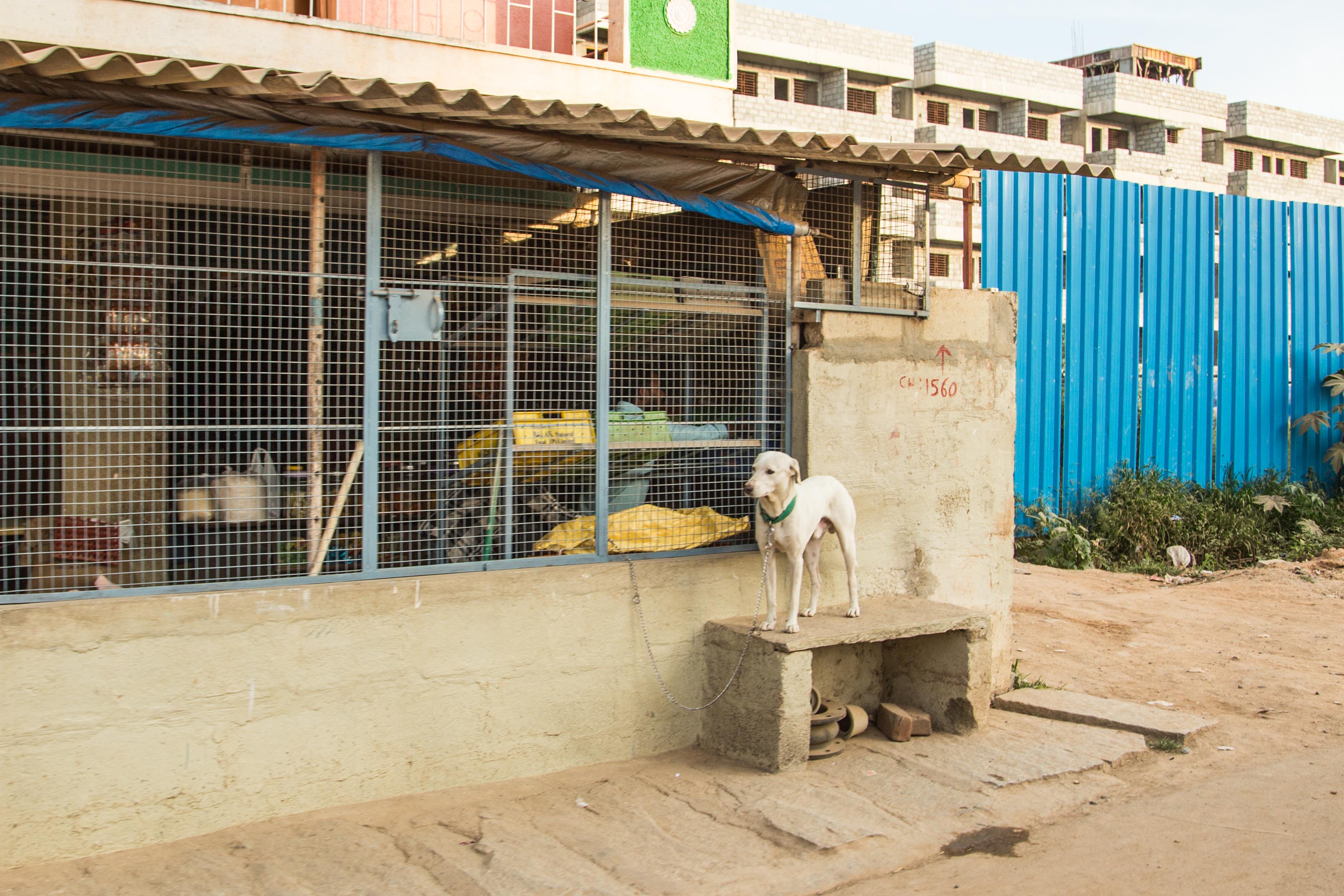
No snakes, but so many dogs.  Half of the following dog pictures were taken this afternoon around our neighborhood over a period of about 2 hours (click on an image to enlarge).  They’re everywhere! And they all look the same. There is a breed called “Indian mongrel”. It’s not a mutt from what I understand, but a full breed. They’re cute and they fit in perfectly here.  They are medium size, with a short coat. Most of them are brown, but we see a fair amount of black and (dirty) white. They have floppy ears and a long tail.

They live in packs and are pretty territorial. There is a group of 8 of them in front of our compound, and another group across the street in front of the hospital.  Whether in an urban or rural setting, they stick together.  They are quiet during the day, each minding their own business, but at night they gather again. Unfortunately, I often hear them barking and fighting in the middle of the night. Not fun!

They are not as skinny as I have seen in other countries. They find food. There is an entire well-oiled ecological system of animal food. Garbage dumps and street garbage piles are a smorgasboard for stray dogs and cows. There is always a vegetable peel, a leftover chicken bone, and if you live in a city, the occasional cookie. They rummage through plastic bags and we have seen a few carry the bags to another location, I assume to share with their buddies.  I have learned that they like to eat flowers, so they often munch on puja flowers!

And these dogs are so smart! They know where human food is: around the tea stalls and all the hotels (hotel means restaurant in India, don’t look for a place to sleep).  They also hang out in front of butcher shops!  And they favor white people over locals: there are a few dogs at the airport who will sit and wait around white people exclusively. They can cross a street better than I can. I have in total seen one dog that got killed in traffic. Considering that it took me a few months to feel comfortable getting to the other side of the street on foot, it is amazing that these dogs can do it without flinching. As I said, they are smart!

When they’re not looking for food, they sleep. And they can sleep anywhere: sidewalk, street, pile of sand, under cars. I saw one today nicely nestled in a pothole.  Yes, that’s how big the potholes are in Bangalore, a dog can use them as beds.

They also run a lot. It’s more of a trot than a full run, on the sidewalk or on the side of the road. They are not wandering, they clearly know where they are going.

They are not particularly friendly. They rarely come to us. They are not aggressive (at least during the day), but seem to have no interest in being petted. There are always a few exceptions as the ones we met on the beach in Goa, the black one with a collar that hangs out in front of the hair salon, and the little puppy that runs around the vegetable stand close to us. But he’s a puppy, he doesn’t know any better yet! People are not mean to them like I have seen in other places. I have seen once kids throwing rocks at a dog. I was none too pleased…  Here, I often see people feed them crumbs and bits and pieces of what they are eating themselves

Very often, their ears are clipped. It means they have been spayed or neutered through a government program of “catch and release”. This is obviously not working too well! We see a lot of doggie mommies, full of milk, looking for food. We were once chased by an angry dog protecting a litter of 6 or 7 puppies.  You also some dogs that have obviously found a mate that was not an Indian Mongrel. The results are some very fluffy dogs, and on the pictures below, some that look more like a Doberman and a Labrador.

Some wear collars, hence some have owners. We also see dogs on a chain. “My” school has a dog. They are trying to teach the kids to respect all creatures. Unfortunately that poor girl gets a bit overwhelmed sometimes being surrounded by 300 kids! I have heard she bit one. She eats chapattis soaked in water or milk, or rice, whatever was served for lunch that day. Only once I saw dog nibblets in her bowl.

Around ITPL dog

They are covered in fleas, which, aside from the risk of being bitten, is another reason why we don’t try to pet them too much. It’s not unusual to see a dog twisted trying to bite at those nasty pests. It is also not uncommon to see a dog that has been injured or has tumors.

And once in a while, we see a “foreign” dog, a non-Indian Mongrel, in a leash.  Dogs have become a status symbol. And the bigger the dog, the bigger the status. In our compound, we have a boxer, a beautiful German Shepard, several Labradors, a very old fat beagle, and a couple of Huskies.  Since they are confined into the homes without a doggie park or much of the required exercise for such big breeds, a few of them are becoming pudgy. We often see dog walkers, or should I say dog pedalers, who ride a bicycle with a dog in tow with tongue hanging on the side, panting.  That’s funny!

We have been trying to convince our driver, jokingly, to get a puppy for his children, but he doesn’t seem thrilled about the idea. Maybe we’ll get him one for Christmas!

Posted on by Kitty Vindaloo | Leave a comment

When you move to a land far, far away, you have to put your life as you know it on hold for a while. One important change is how you manage your health. As you know, a company nurse scared us out of our minds explaining all the evils we would be facing living in India. We got all the necessary shots and then some, we are careful with water, religiously apply mosquito repellent when we go out, avoid petting dogs and care for minor cuts and scrapes. We did all our yearly checkups before boarding the plane. We were shown the “good” doctors when we had our orientation. We have medical insurance coverage, though their list of approved doctors in town does not take into consideration the size and traffic problems of Bangalore, directing us to a doctor four hours away. Useless. There is a state-of-the-art international hospital within walking distance but it’s not on our list of approved doctors. Frustrated, expats often get their check-ups and booboos attended to when they go home.

But life goes on. You may have a scooter accident and have to visit the local hospital! Or you face the fact that some elective surgeries that you had considered in the past are now a necessity and not an option. That’s when you take the plunge and delve into the realm of foreign “third world” medicine.

The insurance battle began. Of course they wouldn’t cover the procedure in India. Of course they then denied the surgery even in the U.S. The HR guy back in San Diego did try to get the insurance to cooperate, but then, frustrated, chimed in with: “Why can’t you wait until your assignment is up”. Dude, that ain’t cool, and it’s not your job. It’s hard enough to have non-medically trained bureaucrats working for insurance companies decide what procedures are necessary, contrary to doctor’s orders; we don’t need input from a benefits coordinator.

So we bit the bullet and decided to pay for it ourselves. No questions asked. No one to breathe down our necks. No paperwork, no delay.

E. found a great doctor in a great clinic. One look at E.’s medical history and a battery of tests, and the surgery was scheduled. Just like that. This is how the medical profession should be run. Dr. M.G. Bhat is so kind. You talk to him and him only, not a slew of administrative assistants and physician’s assistants and registered nurses. The doctor only. Himself. And this guy is so nice, warm and charismatic. Not pushy, not arrogant, not condescending. We met a few of his patients who described the journey to recovery. We even met most of his staff and team in advance. Impressive.

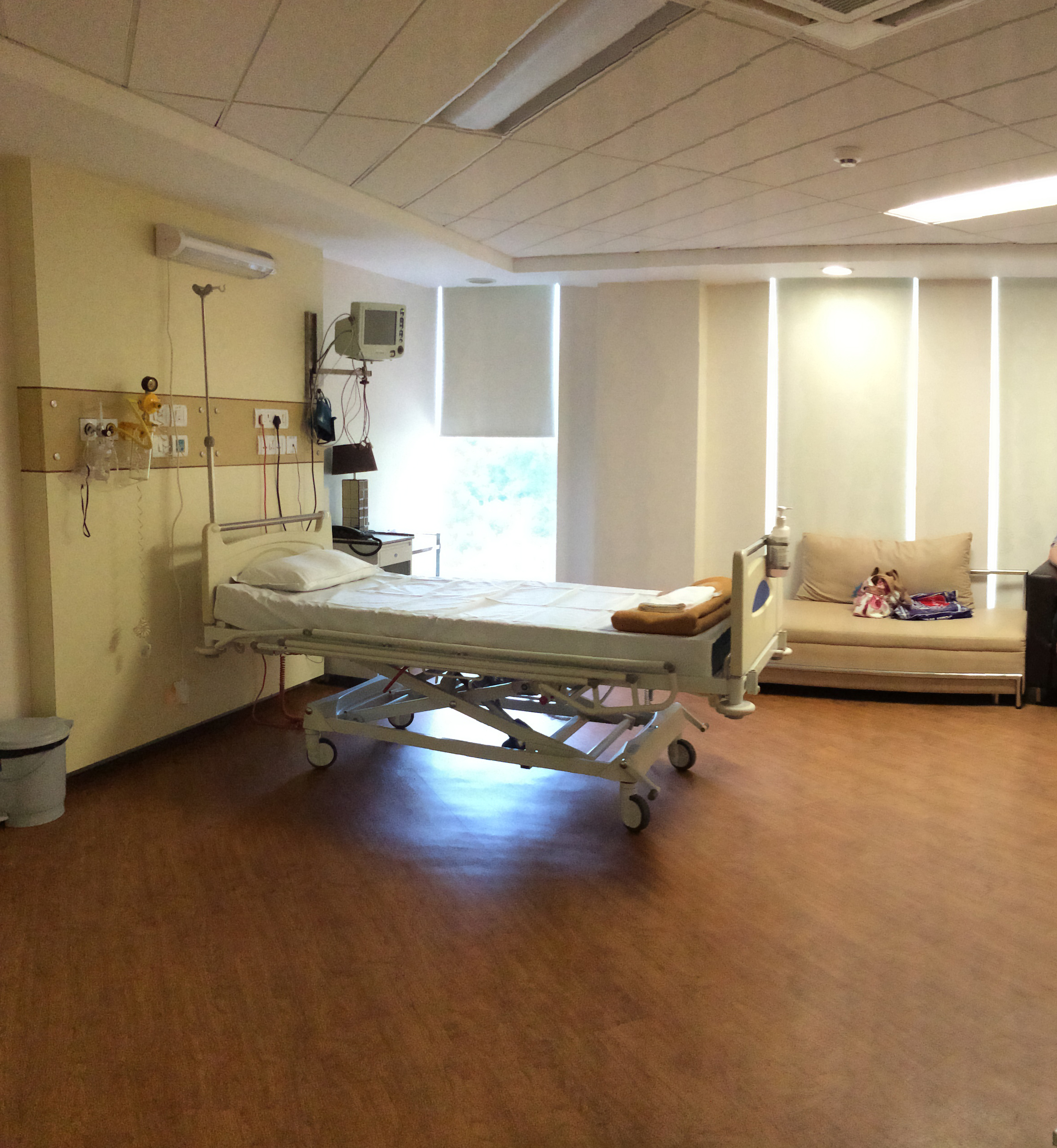
So off to the Nova Specialty Hospital we go, in Koramangala. It’s a private clinic of course, and not an emergency room. Since it’s a bit far from home, we got a hotel room close by so we could be there at 7 am. The hospital had set us up in a room with not one but two nice sofas for me to sleep overnight! Imagine that in the U.S., where hospital visitor hours are managed the same they are in a penitentiary. We waited a bit, they took some vitals, the doctor showed up and they dressed my hubby in a funny looking pink gown. He looked like an Easter Bunny!  We didn’t take a good picture of the room, so here’s only half of it.  Add two black comfortable chairs and another sofa in the right corner.

hospitalroom

Left side of the hospital room

During the surgery, I slept upstairs. Sweet slumber was the best way to fight off the stress. One cleaning lady took a shine to me, holding my hands, hugging me, asking me if E. was my husband or brother, where we live, where we come from, telling me where she lives, asking if I wanted food. Everybody was concerned about my food intake: “Did you have your breakfast, lunch, dinner?” They apologized for only serving South Indian food but could order me anything from outside. They brought me idlis for breakfast and their veg meal/thali for dinner was yummy! The cleaning lady brought me sheets and blankets and a pillow. Just like that, without asking, out of kindness.

The surgery went well.  They called me the minute E. was wheeled into the recovery room. He was still a bit loopy for the anesthesia, with all the good and fun medicines they had pumped into him. He kept telling me how much he loves me! I stayed a while, then got kicked out so he could sleep as I was too much of a distraction for him. Around 6pm, he was taken back to his room.

The night nurse was fun. We talked about Manipur, her home state, her IT professional husband, the difficulties of working a nightshift. Around 2 am, E. and I both feel asleep but I heard her come in regularly, every two hours or so, checking the IV fluids and his pain level. A sweet lady. All nurses were wonderful, kind, efficient.

I will spare you the details. But what should have been a two- or three-night stay turned into one night only. I believe that the great care E. received contributed to his recovering a bit faster.

We are aware that this is not every day Indian medicine. This is not the local hospital around the corner from us. We got top-of-the-line service. It doesn’t hurt to have cash and to be white and residents. They were all very curious, and very proud that we trusted their country for this procedure.

Thank you India for creating some of the best doctors in the world, and not exporting all of them.

Posted on by Kitty Vindaloo | Leave a comment