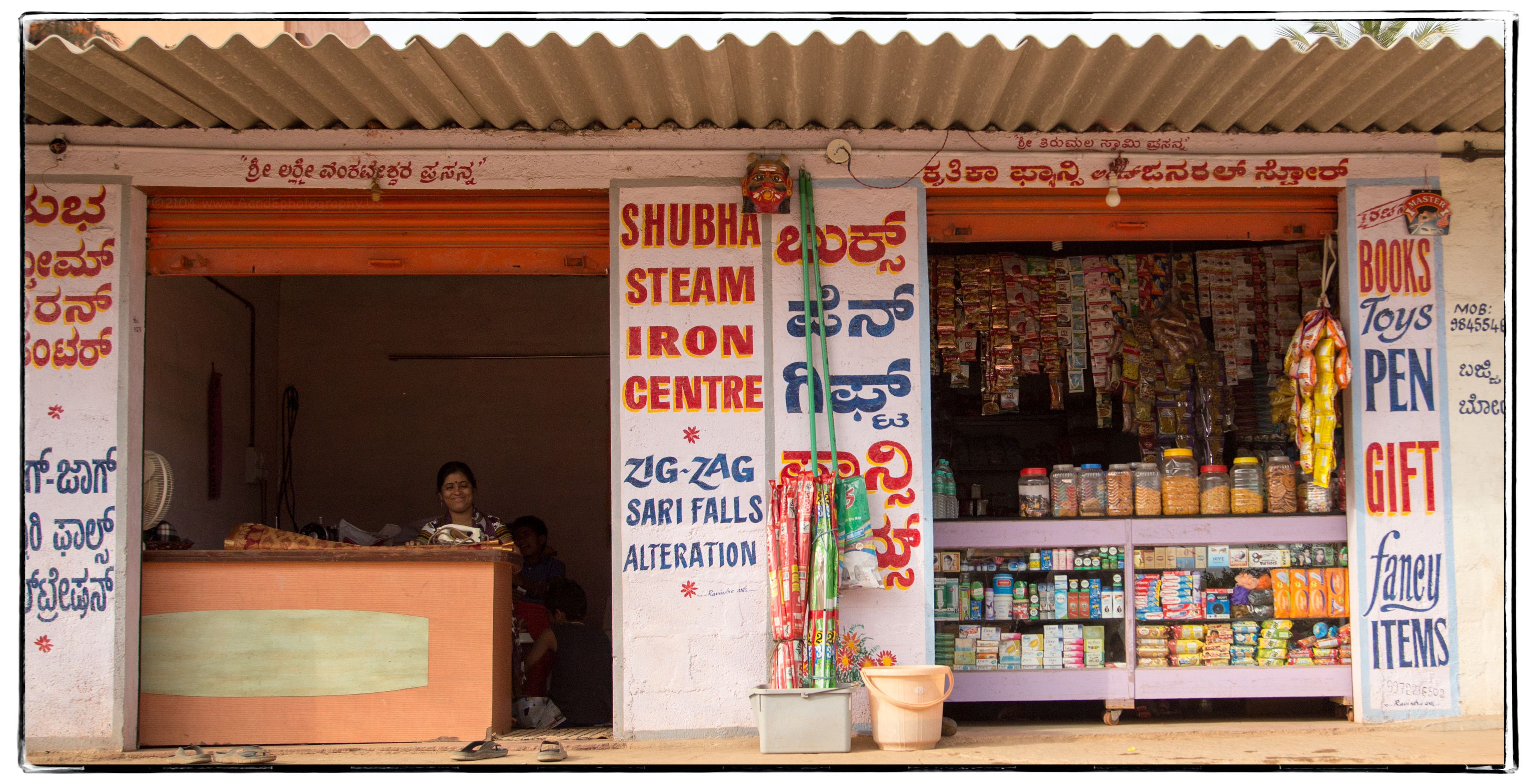
We live off the tourists’ beaten path.  Nobody who’s traveled to India for fun comes back saying: “I went to Bangalore, man, that was so rad…”  Ok, I may be using some old hippy stereotype here, and I don’t think I have ever heard anyone use the term “rad” in real life, but the truth remains: Bangalore is not a city that attracts tourists.  We see tons of foreigners around the software bubbles, ITPL and Electronic City, and they go to work, visit a couple of temples, stay in the nice hotels where the food and the water are safe.  Be careful though, even most five star hotels don’t always have potable water out of the bathroom sinks, so watch out for that Delhi Belly!

My point here is that we are spared the granola munching, traveler’s checks carrying, ganja smoking, patchouli smelling and backpack-hauling crowd.  We do see them once in a while, when they are tired of the homestays and need a good scrub.  You can spot them a mile around as they often try to blend in by wearing Indian clothes, but the wrong way.  I saw a man wearing a churidar (woman’s pants) and don’t get me started on girls wearing the churidar and tank-top combination.  Women in India cover up.  Especially their legs.  And their shoulders.  It is true that a younger professional group wears Western clothes, including sleeveless shirts, but they are rare and few.  You see a lot of tummies with the saris, but no ankles.

But I digress.

kochi--7

Ankles at the beach!

We spent a few days in Kochi, and it has all the above-mentioned people.  It’s a very touristy place.  It’s however lovely.  A couple of friends from the States were vacationing, and hop on a plane we did and visited Kochi.

I told you it’s touristy: we could not for Heaven’s sake, make the young receptionist understand that we live in India and do not have a foreign address.  We tried but failed.  She kept presenting us with a form asking for a foreign address and would not take no for an answer.  I admit that for the first time since we moved here, I raised my voice.  Not loud.  More in the vein of pronouncing each syllable independently, accompanied by a firm pounding of fingers on the counter: we-do-not-live-in-America-we-live-in-Bangalore.  Yes but I need an address, where do you live?  Repeat.  Look, she says while showing me someone else’s form, this man from Spain has an address in Madrid.  We-do-not-live-in-Madrid-we-do-not-live-in-America-we-live-in-Bangalore.  You have an American passport, you live in America (granted here I have had the exact same problem with French banks).  E. who was not as hot headed as I was (yet) crossed out our India address and wrote “USA” in the appropriate box.  She was satisfied with that.

We were traveling with a very well connected crowd.  By this I mean that a quarter of our group is sometimes referred to as “Google Aunty” as she has a connection to the beginnings of Google, like, you know, in the 20th century, and another quarter works for Qualcomm (they make chips that are on your smartphone, that makes you able to use the above mentioned Google and look stuff up).  Yet, we got lost.  And it was fun!  We couldn’t find the restaurant recommended by Trip Advisor so we tried to wing it.  First try, not so good.  We sat down, looked at the menu and while the waiter went away, two gentlemen who were about to leave told us to run!  Hygiene problem they said!  So we ignored our good manners and left.  We are ready for substandard taste or accommodations, but hygiene is not something you want to be callous about.  Bad water can kill you.  Back to Trip Advisor and Google maps.  Ha!  You need an internet connection for that and we were off the grid.  But the surroundings were so pretty.  Dark and scary a bit (I was more scared at hearing my husband going “huh huh!” than by what I was seeing) and so lively.  It was dinnertime and the cooking smells emanating from houses were making us even more hungry.  We did walk pass a river (we’ll call it that) that was littered by a week’s worth of refuse.  That didn’t smell too good.  You had to watch where you stepped.  And we did see a few of the people described in the first paragraph: the people who insist on paying a dollar for a hotel room so they can feel authentic.  Right…  We ended up in what looked like a cafeteria, but where the food was awesome.  Shrimp kebabs with tons of pepper.  Yum.

Kochi is by the sea, so they live off seafood.  During daytime, we were mainly around water, on a boat, on a beach facing the Arabian sea, or Fort Kochi, which is where the fishing boats come back to unload and sell their catch.  We went for a boat ride and got the big boat all to ourselves.  You’d think that in a place with so many white people they would be used to it, but no, wherever we went we became celebrities, wanting pictures with us, the whole shebang!  We passed boats full of young Indian tourists taking pictures with phones, who became our instant distant friends, and ferries full of people going to work, some not too happy. There are also a lot of naval warships.

If there’s one thing that I like above else in this country, it’s the smiles.

We visited a couple of churches, tried to go to Jew Town (it’s the actual name) but it was so crowded that we gave up.  We went to a dance/martial arts representation, once again done for the foreign crowd.  We did a lot of driving, daydreaming of buying an old bungalow, fixing it up and turning it into an orphanage or a hotel or a school or just a nice house to spend a few months out of the year.  If you’ve seen “Hotel Marigold”, you get the idea!

Kochi is very nice.  I could have done without the kids and blind cats being used as photography props for tourists, but it was really pleasant to be able to simply meander around and take it easy.

Minus the patchouli, I really don’t like that!
Posted on by Kitty Vindaloo | 2 Comments

One of the good things about India is that when you run out of things to blog about, poof, something new and adventurous happens.  As you can guess, we had to go to the hospital this afternoon.  In a battle between the scooter, E., and a puddle of mud, the mud won, sending the Vespa for a polishing and E. to the hospital for X-rays.  But we waited 48 hours before going to the hospital, because, well, you know, E. is a guy, and guys are not always smart!

On Monday afternoon, he came back from work with a smirk on his face, a big wound on his forearm and a booboo on his foot.  His ego was more bruised than the rest of his physical body, so we took care of the injuries at home.  But the wound started looking nasty, and the foot was causing more pain.

I will spare you the part on our “international” medical insurance.  Let’s just say that it’s not good.  I am glad we have friends here who guided us towards a reputable facility.

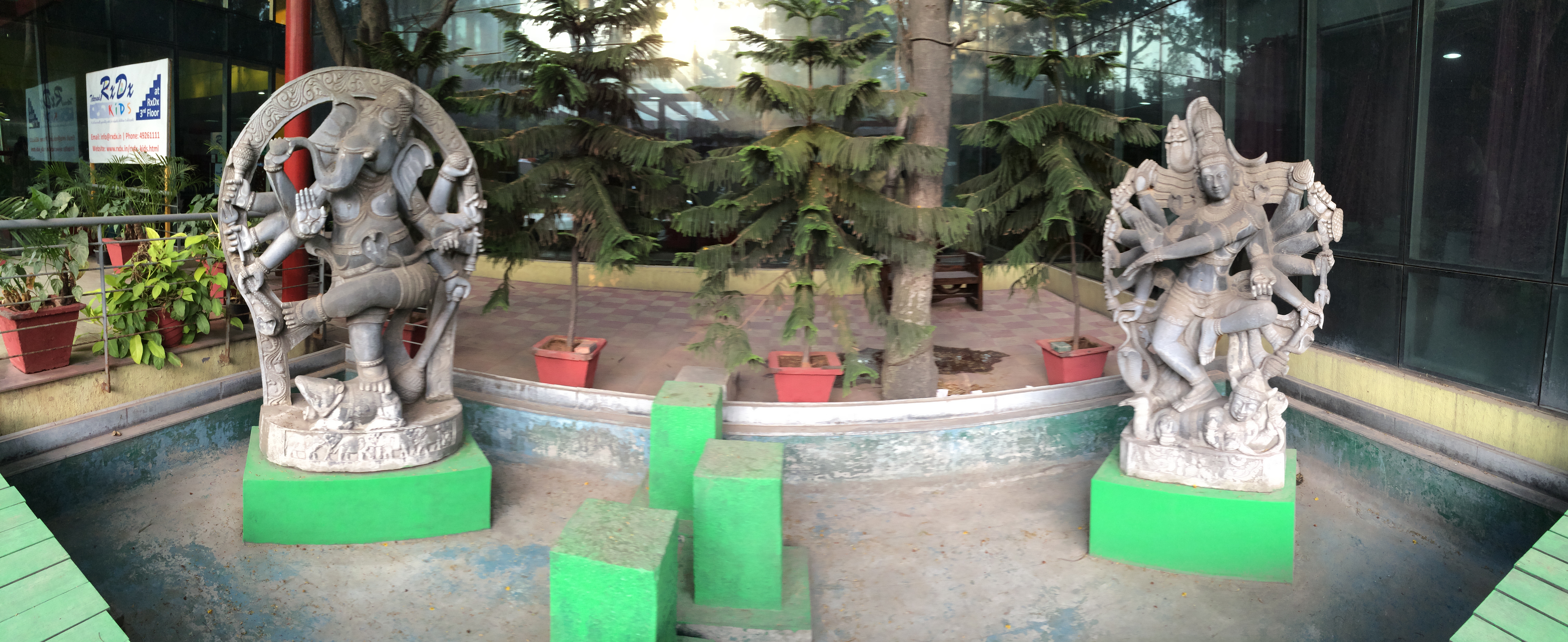
Ganesh and Shiva welcome you to the Brookfield Hospital in Bangalore.  You do need good luck!

Hospital entrance

Hospital entrance

At 3:01 pm, we get in line and pay 350 rupees to be seen by a doctor.  3:04 we sit in the lounge.  3:37 the doctor calls us.  At 3:44, we are out of his office.  He orders X-rays and a clean bandage.  3:45, we pay 250 rupees for the x-rays.  3:47, we are in the waiting room.  4:02, E. goes in for the x-rays and is out at 4:064:13, I kill a mosquito.  4:17, the first doctor comes back.  The foot is indeed broken and will probably require a cast.  I laugh!  We can still go on our mini-vacation with Steve next week he says.  He orders a visit to the orthopedician (yes, that’s the name here) for this afternoon.  4:21, E gets a new dressing on his wound by a tiny petite nurse.  Meanwhile, a smoke alarm is beeping, signifying it needs a new battery.  4:27, he comes out and is sent to a room called “day care” where he lies on a bed.  Now I am hungry.  A second smoke alarm chimes in.  4:56, the orthopedist walks in.  “What happened Erick?”  I can’t hear much but I hear my husband giggle and mention the bag of frozen peas I told him to apply to his foot last night.  5:00, the doctor explains to me that there is no need for a cast.  I plead with him, because I really wanted everybody to decorate it Indian style!  But no, no cast, bummer!  5:03, I go and pay the new doctor and small dressing bill for 425 rupees.  The receptionist doesn’t have enough change, so she goes digging into her purse to give me those 5 rupees.  5:08, I am back next to the “day care” area.  It really doesn’t smell like a hospital in here.  A baby girl starts crying.  5:18, the snack area is unmanned.  I think about taking a bag of cookies and leaving money but decide against it.  I will just wait.  5:22, I now pay the pharmacy bill, 322 rupees for a bandage and some medicine.  He has no change so I have to pay with a credit card.  5:26, I give the bandage I just bought to the nurse who hands it to a man standing with E.  I think there was a foot massage but I am not sure.  5:29, the mother of the above mentioned baby girl changes her diaper right on the couch where I was sitting.  5:32, the male nurse walks out, E. puts his sandals back on.  5:36, we are back in the car.

It was clean, it was efficient, it was quiet, it was nice.  And for less than 20 dollars, even without insurance.  India rocks!

P.S.: I was told there was no foot massage, just a new bandage.

Posted on by Kitty Vindaloo | 2 Comments

I still snoop from hotel windows, and I am not about to stop.  I love watching life in India, everything seems to happen outside, in the open, for everyone to see.  These are my observations from our room in Hyderabad while E. was busy at work.

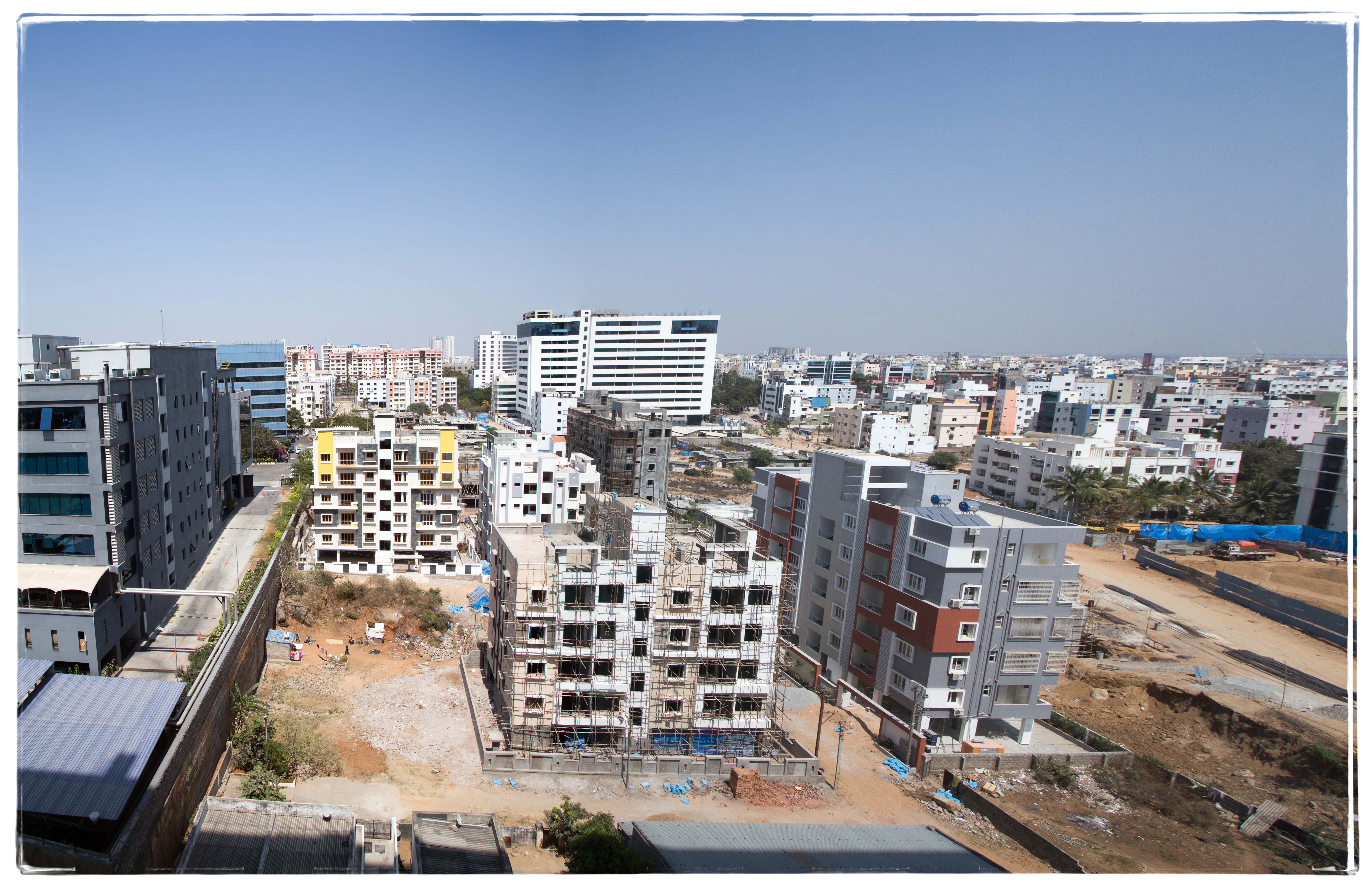
Overview from 15th floor

Overview from 15th floor

Early on when we moved here, Sathya taught us the distinction between the construction workers’ camps and slums.  Workers’ camps are everywhere in Bangalore since the city is victim to massive expansion, and in many other parts of the country.  You can easily spot them with the ubiquitous blue tarps, and often little kids running around, since entire families live there.  I am still not sure what constitutes a slum (legal vs. sociological vs. moral definition), but my understanding is that construction workers are migrant workers, usually from the Northern parts of India, and as can be expected, pack and go when the work is finished.  People who live in slums generally don’t move away, you can easily find people who have lived there for several generations.  What I was looking at were clearly migrant camps.

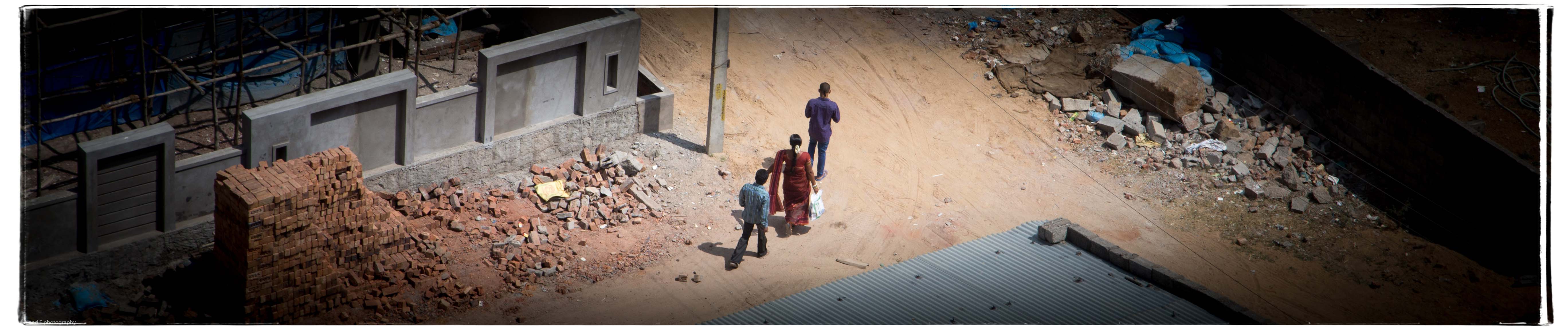
Late in the morning, I “met” a couple living with their young adult son (it’s my story remember, I get to invent who’s who!).  The mother got dressed, then did her hair, very much like I do every morning.  The main difference would be that I don’t go to work in a sari, and I am blonde.  But I loved the details as to how she parted her hair, cleaned her comb, throwing her hair into the air with a flick of her wrist (I would have put it in a trash basket).  Her sari is impeccably pressed, and all her jewellery in place: necklace, anklets, nose ring, toe rings and bangles, each wrist symmetrical to the other.  Meanwhile, her husband was polishing his shoes, he’s probably not a construction worker.  The son?  He first took a shower, outside, with a bucket, with a towel wrapped around his waist.  I did leave when I thought the towel would be dismissed, but no, it never happened, the towel stayed put!  I like his sun tattoo.

About an hour later, the three of them were walking to work.

to work-1712 copy

Then came lunch time.  Two women were alone with children in the “main area”.  Sathya was right, they are ethnically from the Northern parts of India, thought I expected groups from Rajasthan like we see in Bangalore.  They first did the laundry with a bar of soap, a brush and lots of elbow grease, folded yesterday’s clothes that were lying on the outside “bed/sofa”, and changed into fresh clothes.

They then went on to cooking.  The kids were running around, playing with buckets of water, and were carried away by doting parents when they approached the fire pit.  Water was carried in a pot, put on the firepit and one woman was breaking twigs with her food to feed the fire.  I was surprised to see they have a pressure cooker (a must for Indian cooking) and that the guys were pitching in: one washed his hands before sorting out what looks like beans.  I am always impressed by the way they do the dishes in dirty water.  Look closely, you can see mehendi (henna tattoos) on her left hand.

There were many more people working in this neighbourhood.  Take a good look at the woman in a sari and flip flops, bent in half, scraping dirt and rocks into her bowl and hauling it away on her head.  This is a very common sight, yet still disturbing to me.

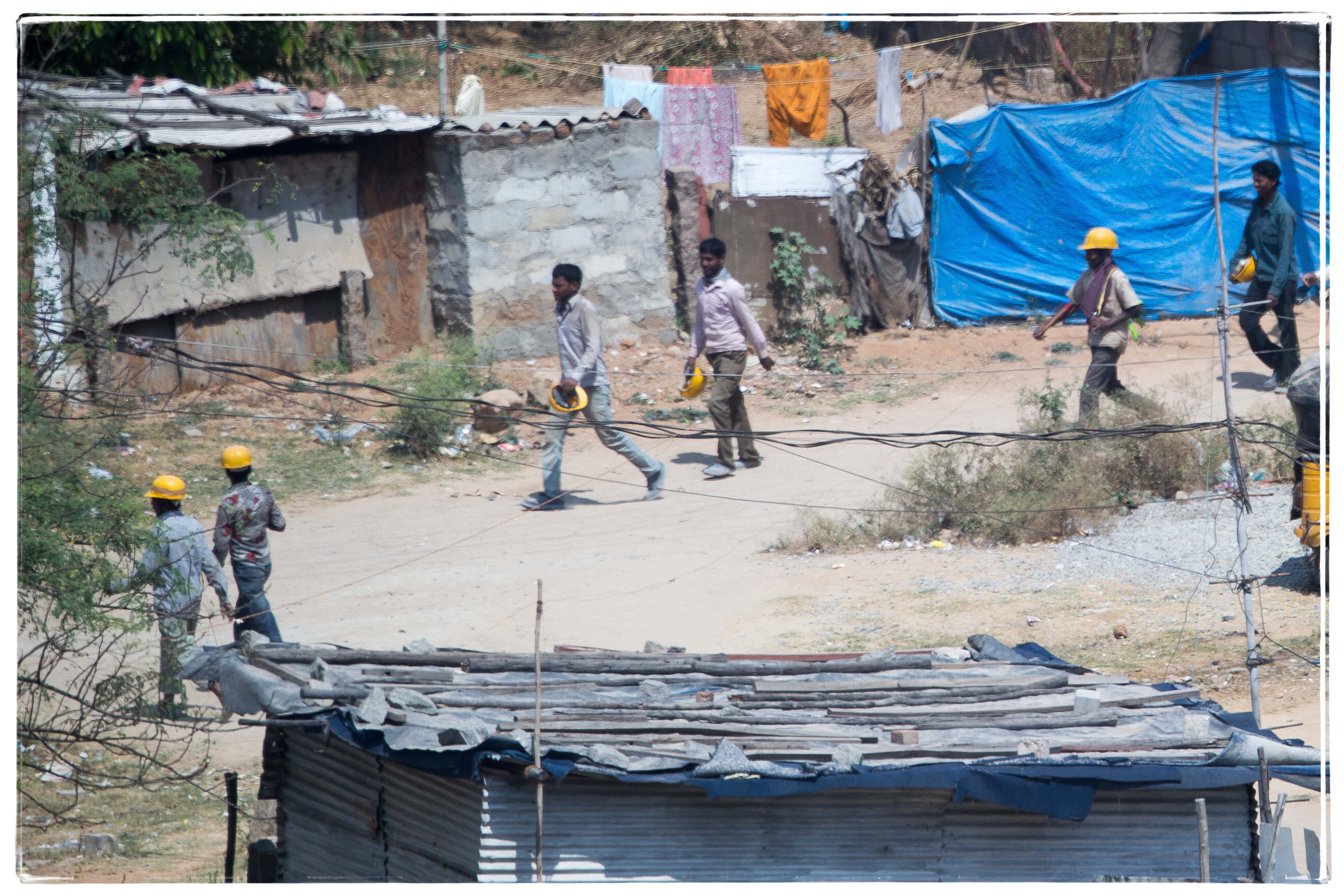
Much further away in what I call the “other housing unit”, the men all came back at the same time for lunch.

lunch worker-7031 copyLet’s put all of this into perspective by adding a legend to the first image posted:

Panoramic view from hotel room

Panoramic view from hotel room

You can see many satellite dishes, yet we didn’t find anything that would remotely resemble a toilet.

We had to change rooms the next day and got a view on a very different group of workers: IT professionals.  The modern side of India is real and growing (I get upset when people say that only rural and poor India is “the real India”), made possible, among others, by all the people shown above.

IT-

During your lunch break, you gotta relax, take your glasses off and lay on the grass, kick off your shoes, yawn and hang out with your friends.

Which grass is being clipped by hand, by gardeners sitting on the ground, moving inch by inch.  That’s what I call a manicured lawn!

Posted on by Kitty Vindaloo | 1 Comment

Three weeks ago in Mumbai, we had seen a lot of men and young boys digging through mud on the beach, looking for something I thought were crabs and fish (previous post).

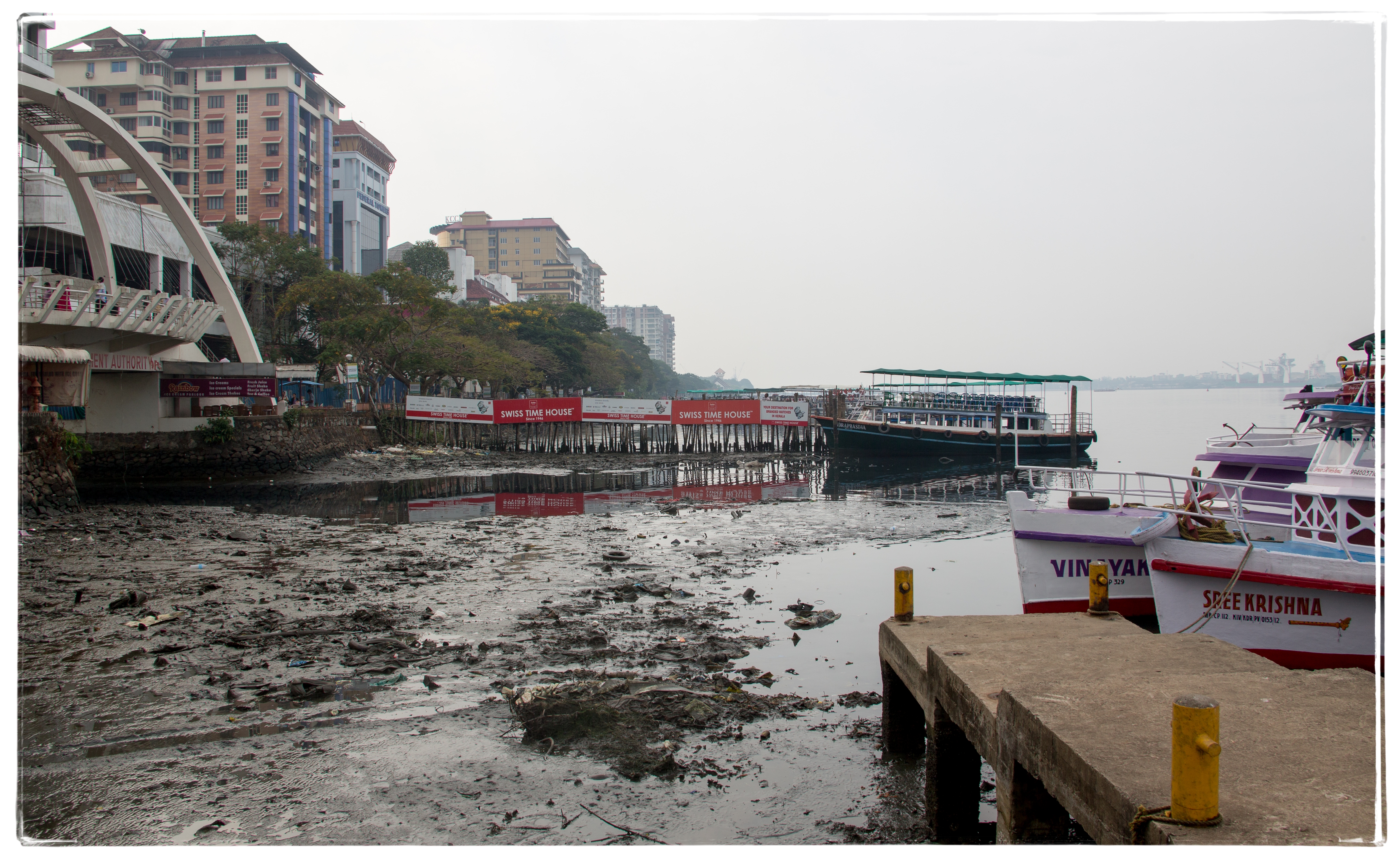
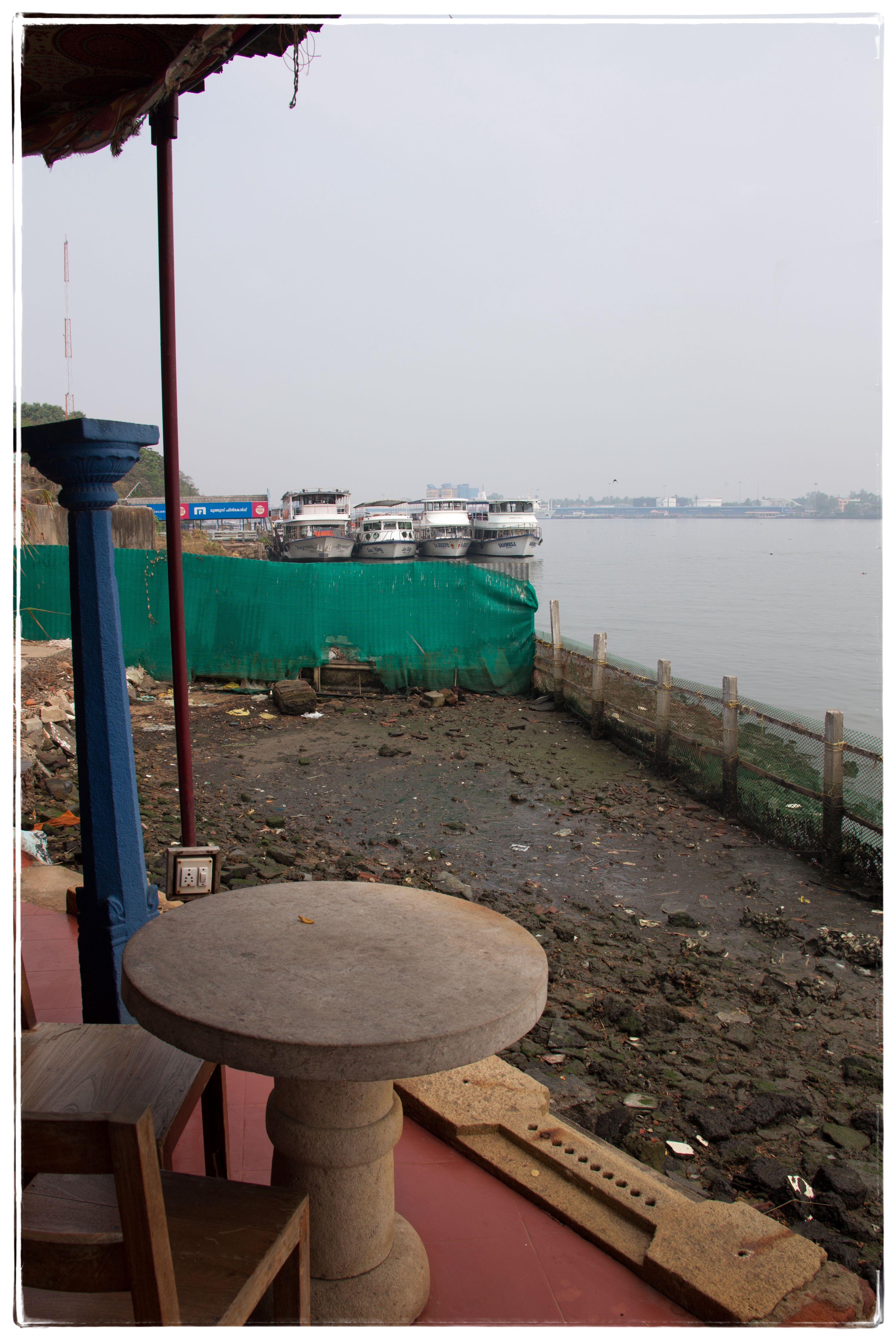
Good news: we found the crabs, though they were in Kochi!  The coastal areas in town are pretty much bordered with sludge, it’s not very pretty.  I need to research the reason behind it.

Kochi seaside with sludge

Kochi seaside with sludge

While sitting by the “beach”, drinking lime ginger soda, we saw little critters coming out from under the rocks.

Coastal restaurant

Coastal restaurant with view on sludge

In a 20-minute span, we saw probably about 30 of them, most of them dark brown, others with red colors.  They were approximately 2 inches from claw to claw.

You can find baskets of crabs for sale at the fish market but they are a bit bigger.  The smaller ones we saw are probably mainly bird food, not human food.

Mud crab

Mud crab

Posted on by Kitty Vindaloo | Leave a comment

We need a maid.  I know I sound like a snob when I say that but there are many reasons why we need a maid.

Everybody has one.  Or two.  And a cook.  And a nanny.  And a gardener.  And a driver.  It is simply expected of us.  1- As rich people in this country, certain activities are considered beneath us.  Huh?  Yep.  The fact that I mopped my floor this afternoon would make more than one woman in our compound gasp.  2-  The trickling down of money is necessary, I wholeheartedly agree with that.  The rich pay the poor to do the tasks they don’t want to do and I don’t want to clean.  3- And our house is big, really big.  It has mostly marble floors and four bathrooms.  Bangalore is very dusty and we live with our windows open all the time.  This means that there is dust everywhere: on the floors, on the window sills, on the stairs (oh! those nasty slippery hard on your feet and malleolus bruiser stairs) and all horizontal surfaces such as coffee tables, television, phones, even the iron work inside the banister.  I can tell you that it is an awful lot of work to get rid of the red dust!

So we need a maid.

Before we moved here, we were delighted that we wouldn’t have to lift a finger, that the house would be run for us.  Oh, how we dreamt of having the laundry folded and neatly placed on the shelves.  But I had also been told that “managing the maids” would be a chore.  I didn’t believe it since I didn’t know what that meant.  I had been told that we would have to teach them how we want things done.  I thought that came from picky people who want the line around the faucets scrubbed with a toothbrush everyday.  I am not picky!  How can having everything done for you efficiently at such an affordable price be an inconvenience?  Now I know.  Hence, we don’t have a maid.  Or a cook.

But I only want a maid part-time.  It is not unusual to see full-time maids, even live-in maids.  That’s what the “servant’s room” is supposed to be for.  Many middle and upper-class Indians, as well as expats, especially if they have kids, have a full-time maid and nanny, sometimes both.  That means having someone in your house all the time.  And that means more or less ignoring that person all the time.  I can’t do that, I can’t live with someone in my house as if they were transparent, non existent.  I don’t want someone here when I am not decent, when I am on the phone, when I read a book, when I cut my nails, when I want to take a nap, when I am arguing with my husband!  I can’t dance Bollywood-style as if no one is watching, because someone is watching!  It is a valid point that I could get dressed completely in the morning and stop arguing with E, but it’s easier for me to pass on the full-time help!  Some people give their key so the work is done while they are away.  I didn’t do it in the US, I am not going to start now.

The first few days after we moved, wannabe maids were lining up at our door all day long.  Back in December, I checked many of the letters of recommendation and was astounded to see the negative feedback.  For one of them, I was told by not one, but several ex-expats that the woman was a nightmare, and that despite the fact that she was carrying decent references, I had to read between the lines.  “She cleans and cooks” doesn’t mean she does either well.  Live and learn! Therefore I decided if the people who wrote those letters don’t respond, I won’t press it.

We hired one lady, with whom I clicked.  Her first day was Christmas Eve.  She was funny, seemed efficient and eager to work, we could understand each other’s English, and her previous employers only had good things to say about her.  The first time was wonderful.  She even cleaned out the refrigerator (that’s called “having a sense of initiative” in reference letters).  She cooked an amazing meal, with several courses.  We were in heaven.  Then I realized that she was cooking less, and she didn’t have time to finish the cleaning.  No problem (yet).  I had been told she has a sister with whom she worked in tandem, one cooking, the other cleaning.  I thought it was a grand idea.  I was wrong.  Hiring the sister was the beginning of the end.

First they argued over the salary.  I didn’t want to have long discussions over how much I would pay one, then how much I would pay the other, so I gave them a very high price for both.  After they made sure bonuses would be added, all catholic and major hindu religious, state, national and city holidays were off, they happily agreed.  However, twenty minutes later, the sister comes back to me, quite aggressive, asking for more because the first one wanted too much of that chunk.  No.  I don’t know what happened between the two of them, but they didn’t ask for more money.  They also stopped talking to each other while working here.

But they asked for “stuff”.  They had me buy four different brooms, one toilet brush for each bathroom, different sponges and a long list of cleaning products.  Ok, I thought, we are all comfortable with our cleaning supplies, I personally think 409 and Lysol (both of which we find here) do a great job on most surfaces, but if they are more efficient with their brands, fine.  To this day, three of the brooms and two of the toilet brushes are still in their plastic wrap.  This tells you a bit of what is to come.

I was clear that I didn’t want any organizing done.  I just want the floors, bathrooms and kitchen cleaned.  There was a silent battle of the wills over a winter coat that I had left on a bed because our little kitten likes to sleep on it.  In one afternoon, I took it off the hanger and put it back on the bed three times.  They insisted on cleaning the outside patio.  In a reference letter, this too would fall under the category of “initiative”.  But the bathrooms weren’t done.  They unplugged every bit of electronic equipment and lamps, and neatly wrapped and tied the cords up.  Can you imagine how my favorite geek reacted to having to replug everything that night?  The kitchen counter was wiped but not clean (note to self: never have black granite in a kitchen).  They insisted on shaking the sofa cushions but didn’t clean the mirrors, after specifically asking me to buy Windex.  It is true that they organized the pantry staples into neat boxes, one for onions, one for potatoes, but in the process they put the super dangerous Permethrin next to garlic.  They decided that anti-bacterial wipes and anti-mosquito wipes needed to be together in a big “wipe” box.  A wipe is a wipe, right (in case you’re wondering, they both read English)!  And my favorite: we had several bags of mixed mini chocolates (yes, yum!!) that they meticulously divided and stored into plastic bags, one for KitKats, one for Snickers, one for MnMs…  Yet the stairs were neither swept nor mopped.  The sense of initiative was giving way to necessary cleaning.  We were told by a neighbor that they had been testing us.  Enough.

Back to square one.  The word got out and the line started again.  But we haven’t been able to find a suitable one.  Do I sound like a snob again?  Yes, and I am painfully aware of that.  Make no mistake about it: guilt follows you everywhere in India.  Back to thinking of myself as a snobbish expat bossing the maids who live on the edge of poverty.  Back to the maids coming to the front door at some ungodly early hour.  Back to sweeping the floor myself, since most maids don’t want a part-time job.  This puts a new spin on my personal definition of poverty.

A friend who lives in the same compound told me her maid is in a difficult financial situation since her husband’s death and needs additional work.  She comes to her house 4 hours a day 5 times a week.  But she turned down my offer of half that salary for 4 hours a week.  She would only accept if I convince my friend to let her leave two hours early without changing her pay.  This was my first, not last, experience of a maid trying to pin an employer against another.  No.

The salary structure makes very little sense to me.  There has to be a rationale, but I don’t get it.  A maid wants X rupees for a full time job.  Double that if you’re a foreigner.  If they work half time, they want about 80% of that, even if they work only four hours a week, which is what I want.  The compound association had given us written salary guidelines to avoid jealousies among personnel working here, but they would hear none of it.  I told them I don’t think it’s fair or reasonable, but their mind works differently.  Basically at this point, what they want to be paid per hour is the equivalent of four times what a software engineer earns. I understand they work piece meal, but still, I am very confused.

E. and I believe that there is a big window of opportunity for a service that would provide cleaning according to expat expectations, a Desi Merry Maids of sorts.  Tomorrow we’ll talk to Sathya and see if he’s willing to start this business with us!

I have not yet given up on the idea of buying a Roomba, an automatic sweeper/mopper.  That’s how thin my patience has run.

Posted on by Kitty Vindaloo | 1 Comment

A lot of my life here is spent watching people.  Sometimes I am simply walking to stores around our house, sometimes riding on the back of the Vespa, and if I follow E. on business trips, often from the hotel room windows.  The following was taken from our room in Mumbai.  It’s pretty blah, until you know what to look at.

In front of the Taj Mahal Hotel

In front of the Taj Mahal Hotel

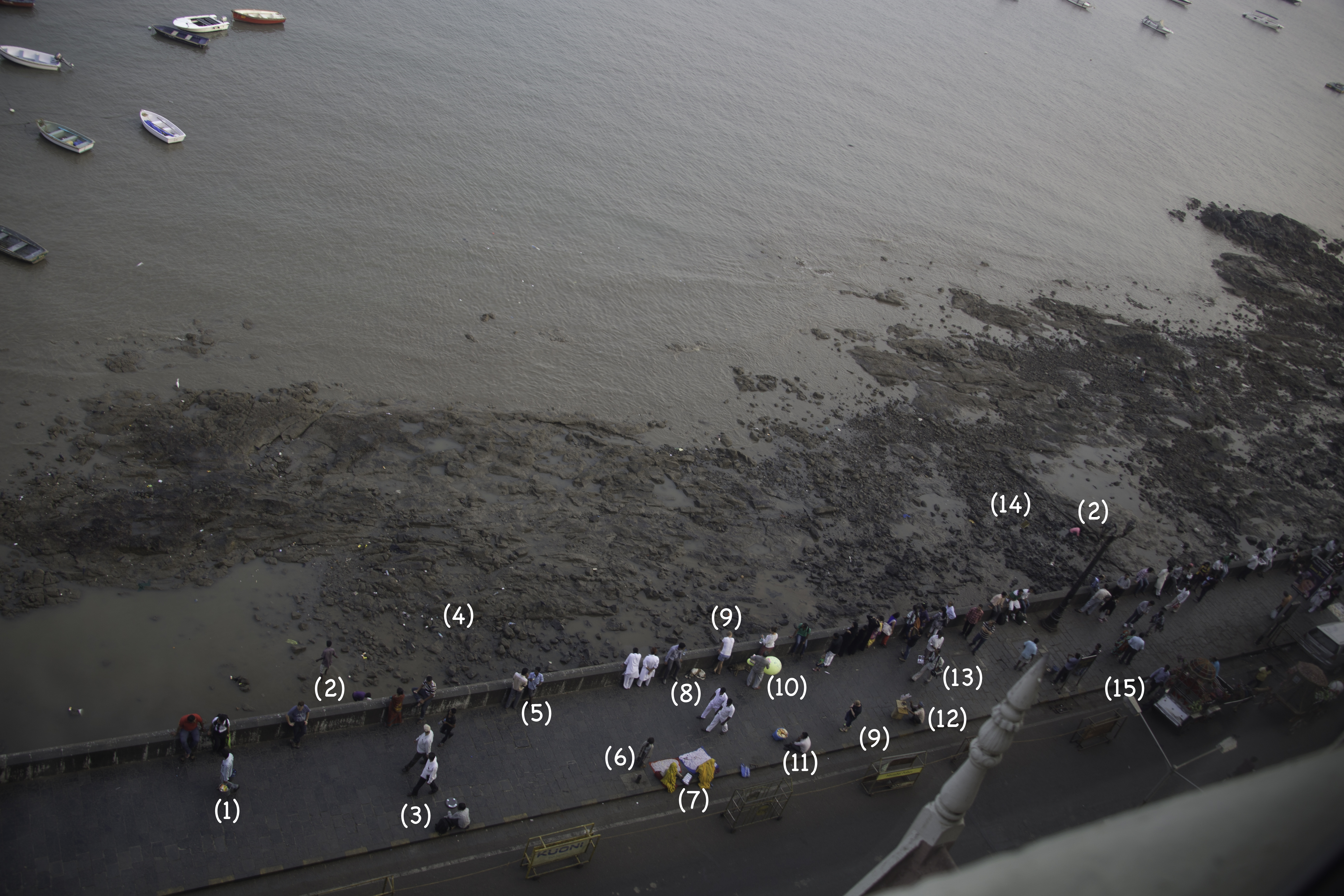
(1) Man selling water and soft drinks that he carries in a bucket in each hand.  (2) Man fishing through the mud.  (3) Man with a scale so you can weight yourself.  (4) Empty plastic bottles and other trash.  (5) Two men eating ice cream.  (6) Beggar.  (7) Women selling assorted plastic knick-knack.  (8) Dog.  (9) White tourist.  (10) Balloonwala.  (11) Man selling fruit.  (12) Man selling peanuts.  (13) Photographer carrying a small printer so you get your portraits on the spot.  (14) Idol (trust me, it’s a framed painting of a god or idol).  (15)  Carriage rides.

That’s why I can spend hours looking through a window.

More often than not, I become obsessed with something I see and research the issue.  It happened here with the men and kids sifting through mud, but I wasn’t very successful in finding the answer.  I had seen a documentary about it on Thalassa, a French TV program a few months ago “Bombay, la cité des rêves” (“Bombay, the city of dreams”, they didn’t bother changing its name to the current one).

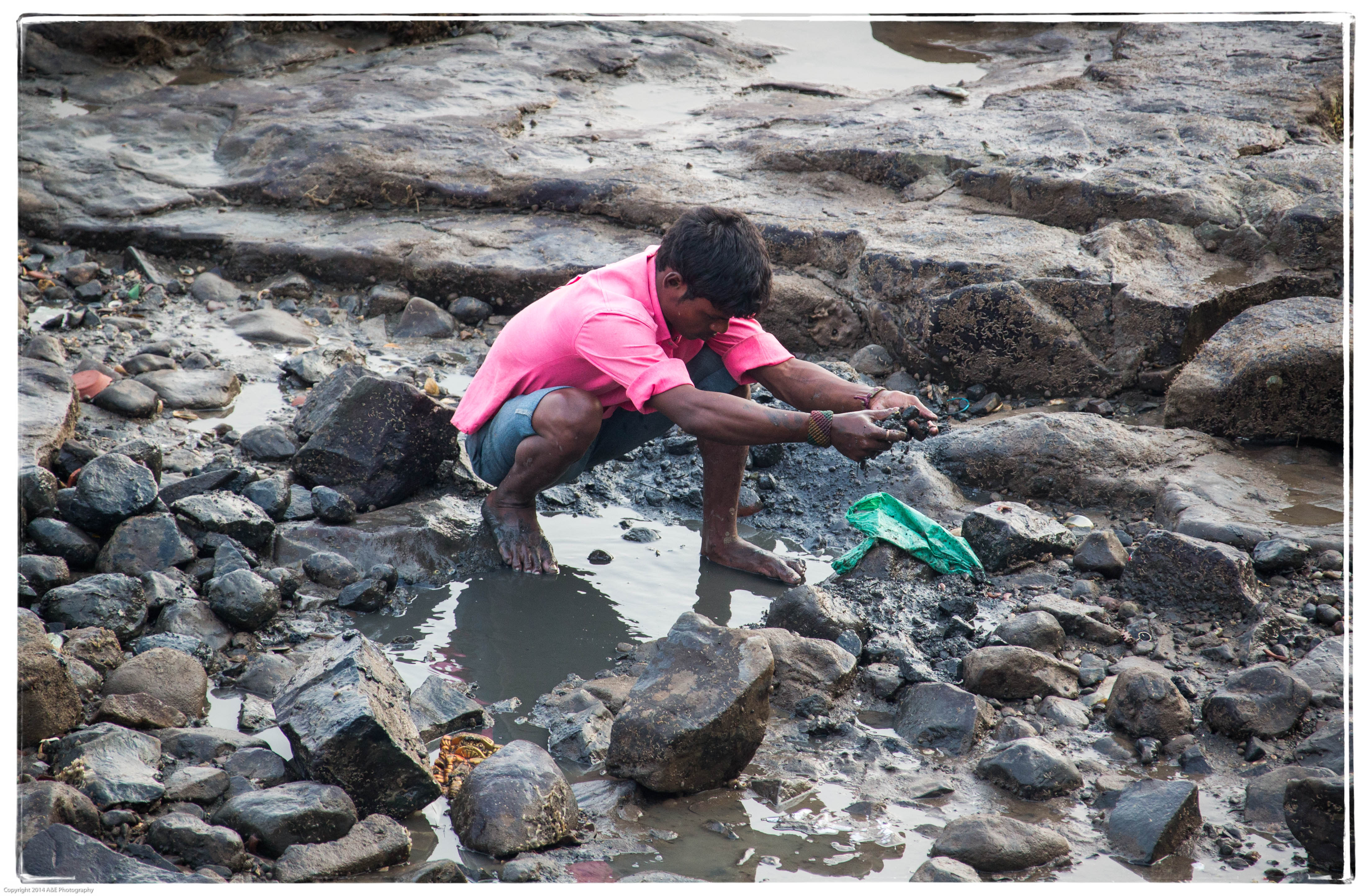
I think they are looking for small crabs and little fish trapped in between the rocks at low tide.  If you look carefully, you’ll see that the man in the pink shirt has an gold colored statue of a god to his right.  Since the idols were clean compared to the rest, I believe the fishermen brought them themselves.  There is a religious festival in Mumbai where they release Ganesh statues into the sea, but those looked too new, and one was clearly neatly leaning against a rock (number 14 above).

mud

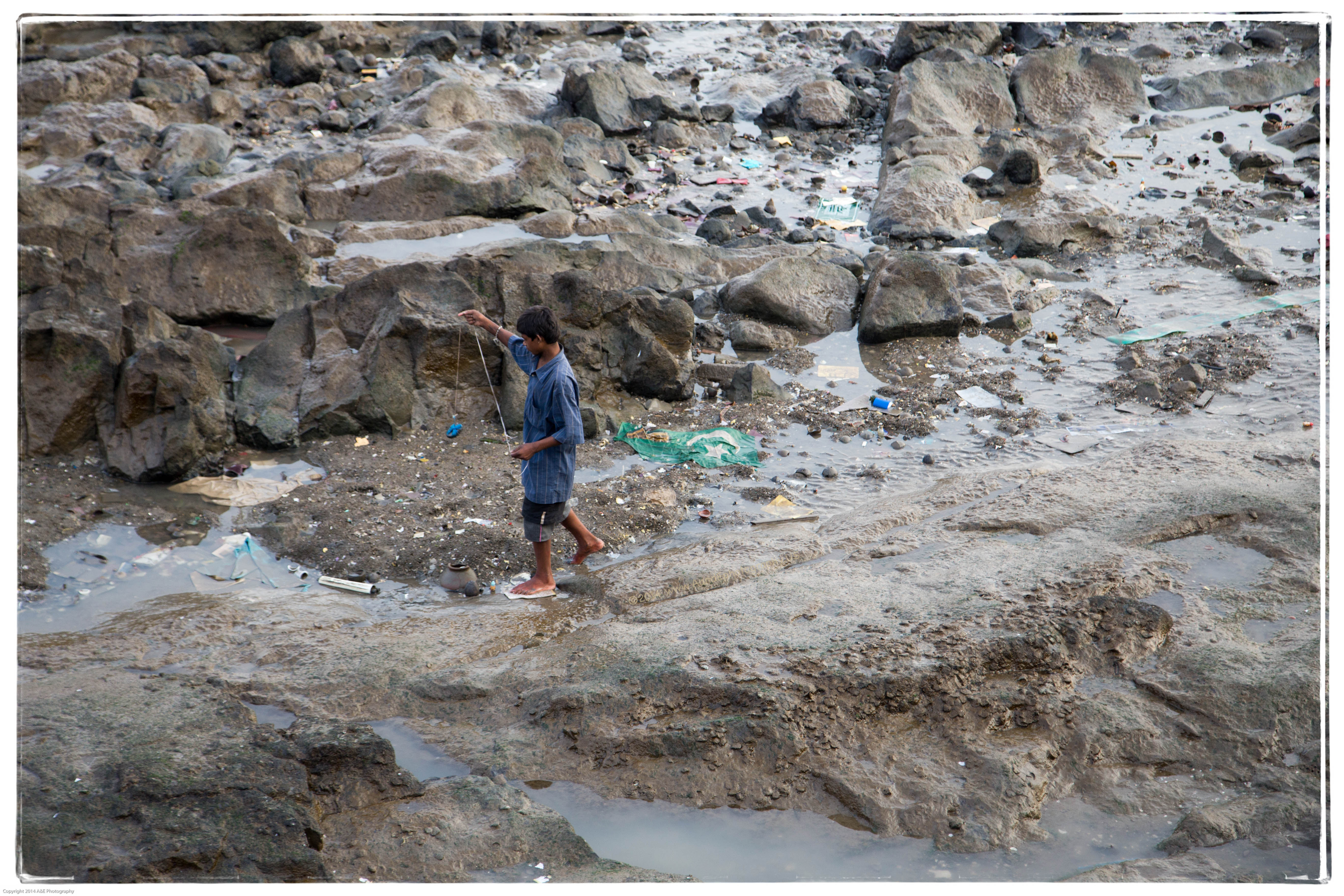
They either dig with their hands, or use I don’t know what, wrapped into pieces of fabric held onto a string.  It reminds me of the frog catching method.  One has to wonder why a tattered flag from Pakistan is tossed into the sea, next to discarded pottery.

mud-2 copy

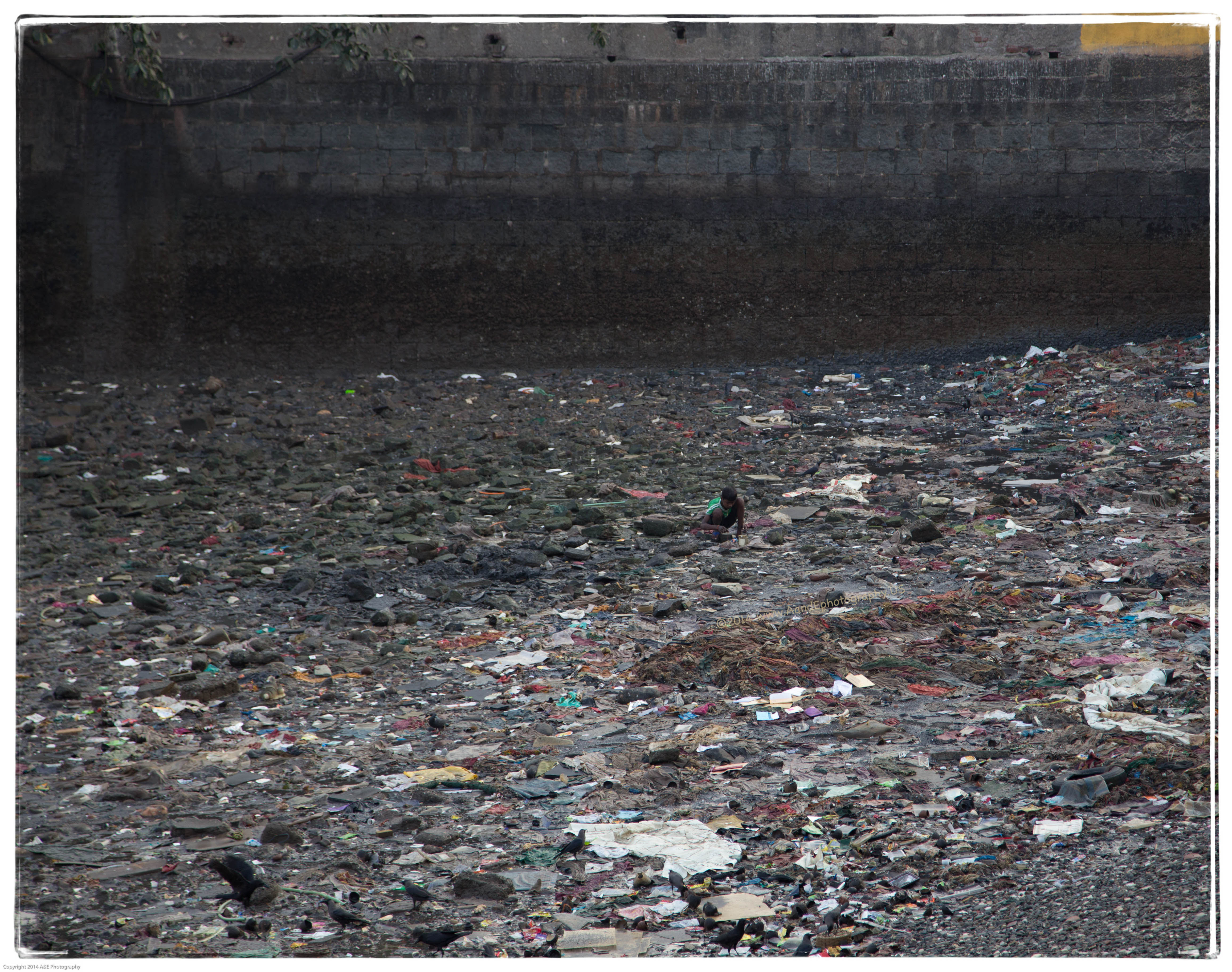
They are not rag pickers.  On the bottom image, the kid was picking through mud and not interested in the clothes and fishing nets trashed around him.

mud-3 And the black birds in the foreground were too searching for their food.

Posted on by Kitty Vindaloo | 1 Comment

I have devised a system where I nestle the camera between E. and me while riding the scooter into the villages, so I can press the shutter, wave and smile, and not fall of the machine, all of that simultaneously.  It’s the scooter equivalent of “shooting from the hip”.  I have a lot of photos of people from the villages, and since we have been going to the same area quite a few times, I now remember them and know where they live.  Last week I printed them, and tonight we went on a mission looking for these people.

It usually goes like this: I see someone whose picture I have with me, tap E. on the shoulder to stop on the side of the, let’s call it “road”.  I get off the scooter, walk toward the person with the picture and hand it to them with both hands, signaling that it’s a gift.  There is a second of hesitation.  They take it, look at it, with a bit of apprehension.  Once they recognize themselves, it never fails: they look up at me, laugh, and call for someone else to come and look (Indians are never alone, there is always someone close by), they all laugh, and then I hear “something something photo something something”.  None of them so far spoke English beyond “thank you”.  Which I don’t really need, the smiles and the laughs are enough.

Posted on by Kitty Vindaloo | 4 Comments

We were in Mumbai for a few days and became full tourists again, as opposed to our regular status of “expats” in Bangalore.

Mumbai is more cosmopolitan than Bangalore, has more Ambassador cars, more beggars, more disciplined drivers, more visible slums, more luxury cars, more air pollution, more foreigners, more tourists, more smokers, more historical buildings, more police officers, more women with short shirts and high heels, more chaiwalas*, more balloonwalas, more displays of wealth, and more cats.  In return, it has less dust, less trash in the streets but plenty in the sea, fewer tuk-tuks, fewer pedestrians, fewer bicycles, fewer cows, fewer smiling people, fewer new constructions, and fewer dogs.  (*walas are street sellers).

Mumbai is located on a peninsula pointing into the Arabian Sea.  So if we swim, we can go and meet our buddy Steve.  But that would require swimming through layers of discarded plastics, vegetable peels, abandoned idol statues, papers and other refuse such as medicine still in the pack, pass hundreds of little boats, pass some big ol’ cargo ships we see in the horizon.  Sorry Steve, we’ll just pass on this one!

boat

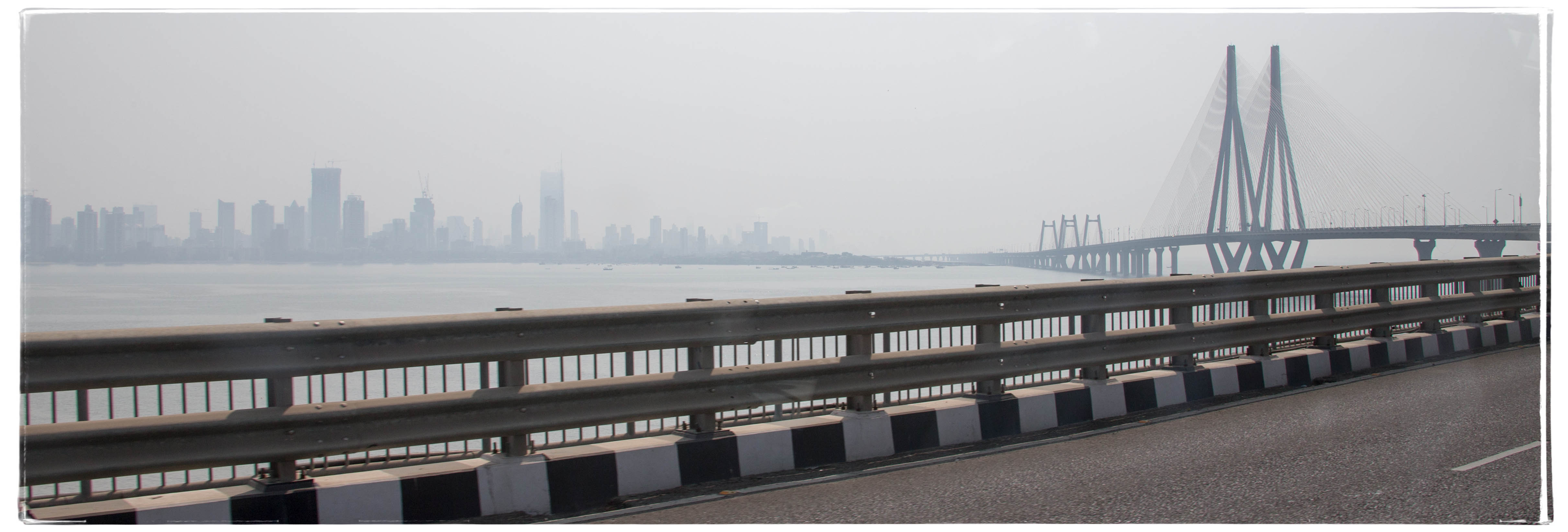
But the view can be breathtaking.  That’s if you can see at all.  On our drive to E.’s meeting one morning, we could hardly see the skyscrapers.

Mumbai skyline in the fog

Mumbai skyline in the fog

It is a very modern city, yet with beautiful old Victorian buildings with exquisite cornices  on outside façade decorations and on balconies.  You see them on the sea front as well as in the heart of the city.  Many of them are covered in black mildew, in desperate need of a facelift, and there seems to be a lot of it being done.  There are more new constructions in Bangalore than in Mumbai.  The work in Mumbai seems to be the revamping of older buildings.  However in some suburbs, new skyscrapers with offices are coming up.

We did a lot of people watching from our hotel room.  We had a view on The Gateway to India and the sea front below us, where a lot of tourists, Indian and foreigners, go for a stroll.

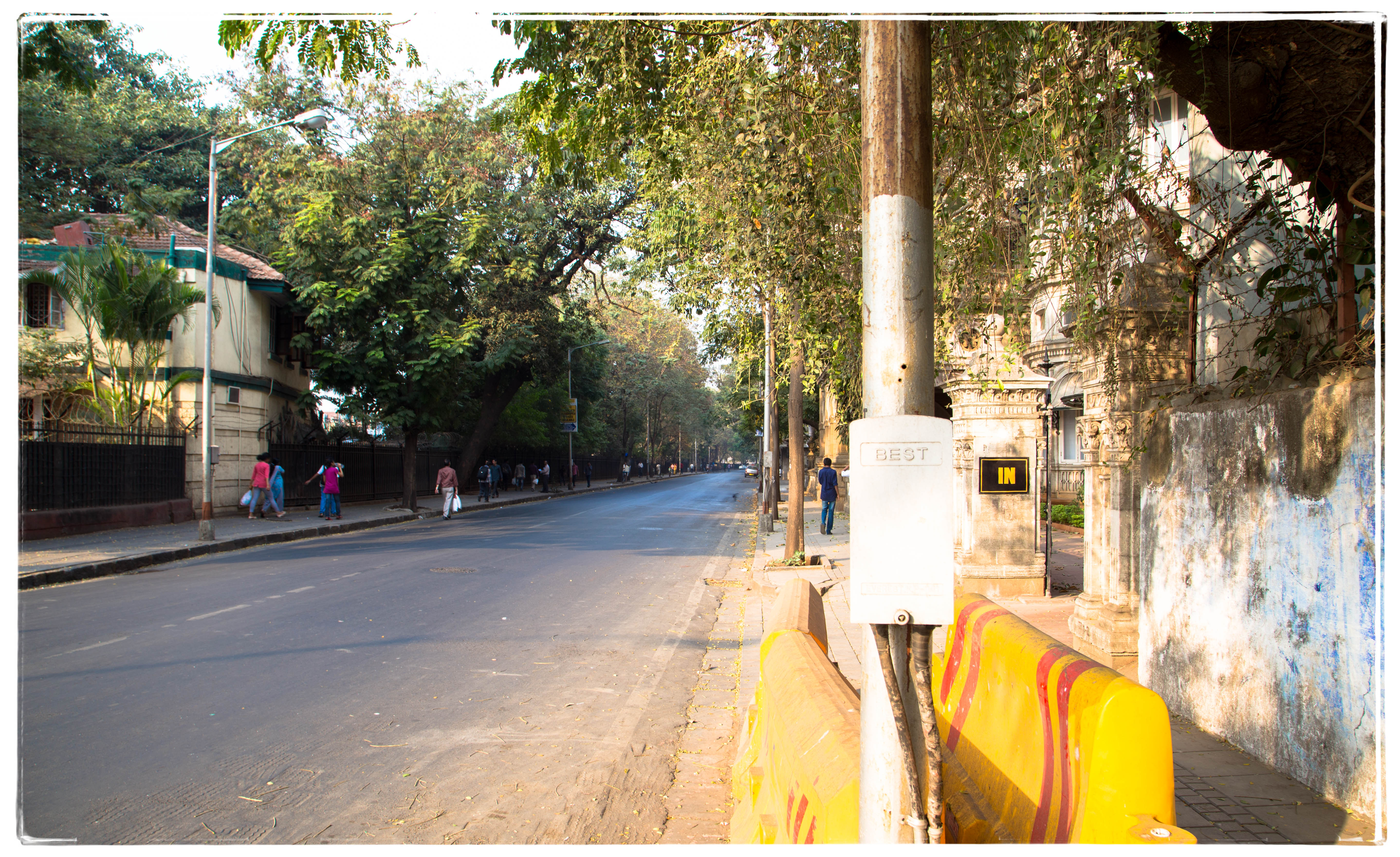
We went to the Kala Ghoda festival, which was very crowded and could have been any arts and crafts festival in the U.S.  We walked around town a lot.  It is amazing to me how some areas of town look like Paris, or the Old Town in Geneva.  A street with sidewalks, no cows, no dogs, fewer than 5 people per square meter and no dust is unheard of in Bangalore.  We are very surprised that we didn’t see massive crowds everywhere, since Mumbai is known for having one of the highest population density in the world.

Paris in the fall?

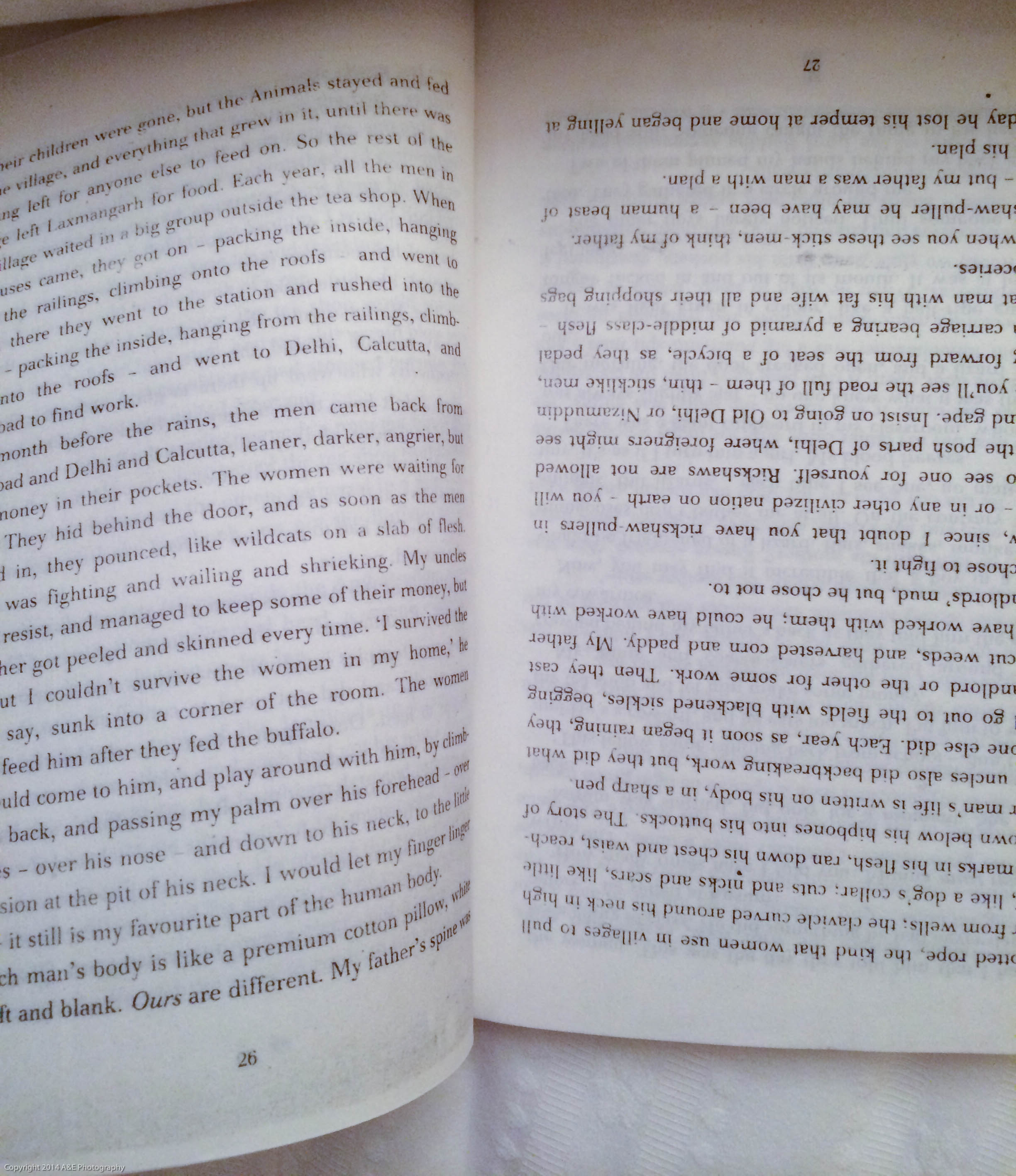
We passed dozens of stalls selling everything from travel irons, business card holders and electric shavers, some new, some clearly used.  Many were displaying a large collection of sex toys.  ‘nuf said!  We bought a few books.  I was impressed by the librarian’s ability to figure out my tastes.  I had already read more than half the books he suggested.  I knew they were not the brand new hard copies you find in the regular bookstores, I honestly thought they were stolen books, or the rejects from the publishers.  But no, they are bound photocopies of the originals.  I encountered two problems, both solvable.  Here is a picture of the first one.

Book pages

As for the second problem, in the last 30 pages of the book, which I enjoyed a lot, every other page was blank!  It is very frustrating when you want to know the end! So I did the right thing, went to a bookstore at the mall back in Bangalore and bought the book a second time.  This time, I purchased the official, regular priced one.  That will teach me!

We also went on a private tour of “off beaten path” Mumbai in a nice air-conditioned SUV.  The young guide met us at the hotel.  We weren’t even in the car yet that he had already verbally given us his business card: born, raised and still living in Dharavi, one of the biggest slum of India, as well as a third year college student graduating in April.  Take that!  Then we meet his colleague, another university student from the same neighborhood, also studying to become a guide for the same company.  Both have dreams of a getting a Master’s degree in their field.  They first took us to have chai (Indian tea), because chai is a religion here!  Then they took us to the Dabbawalas, the fish market, the Koli Fishermen’s village, the Mahalaxmi Dhobi ghats, the thieves market and lastly, Spice lane, all of that in about 4 hours.  The tour was peppered with insights about life from two 20-year-old guys.  Lemme tell you, it ain’t fun being a woman in India.  The off the cuff sexist remarks kept me glued to my seat a couple of times…  But it was truly wonderful.

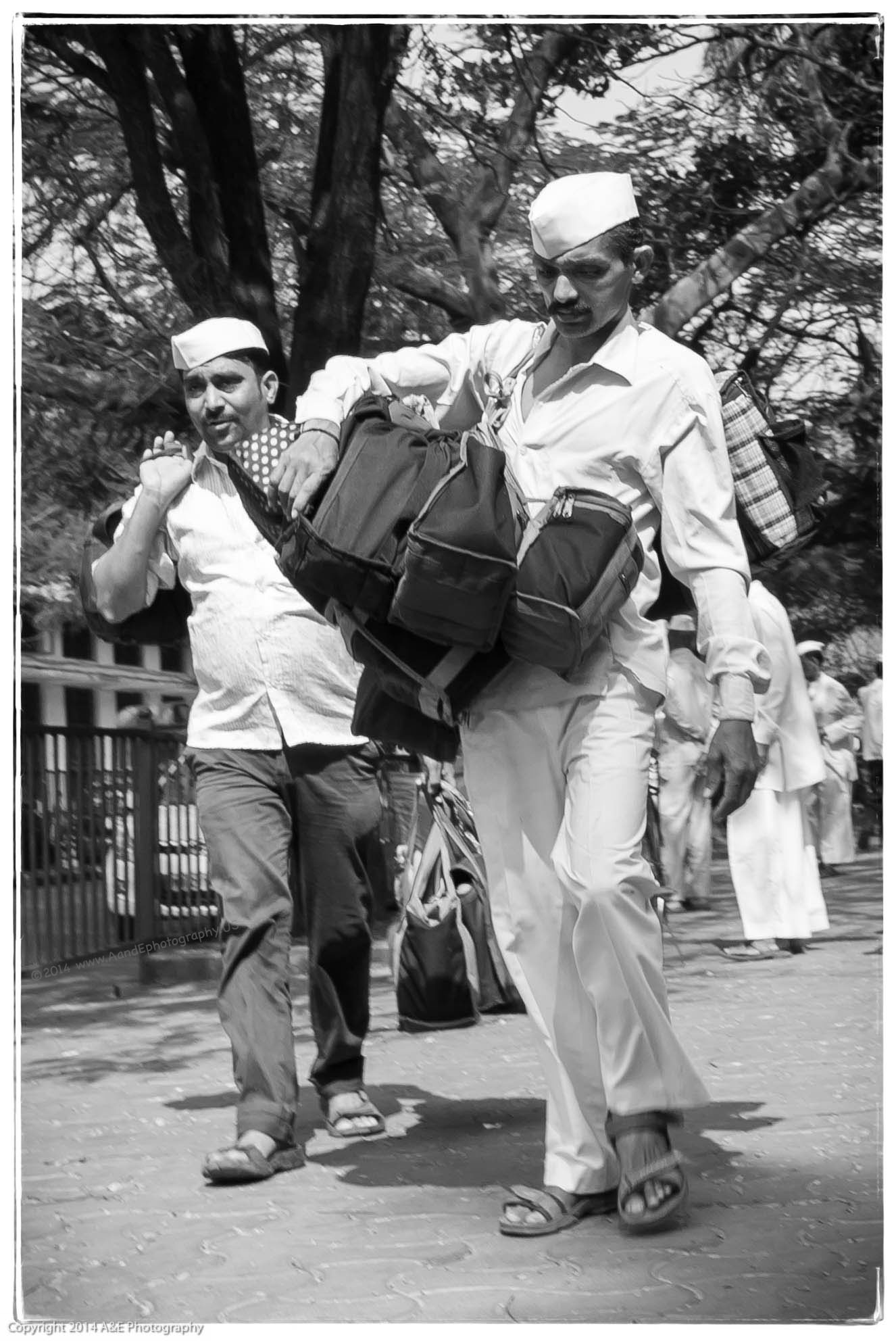
Mumbai is known all over the world for the system of lunch deliveries.  Everyday around noon, an army of 5000 old(er) men, called dabbawalas distribute about 200000 lunches from the wives to the husbands, and then the lunch boxes are picked up and delivered back to the wives.  Without a glitch.  Yet they still can’t fix our stupid dryer.  http://mumbaidabbawala.in/

The system is so efficient that it is said people at MIT study it.  Unfortunately, we were there on a Saturday, which is a very slow day for them, so on an excitement level, it was a 6 out of 10.  But E. got to wear a Marathi hat and make two of those men almost cough up their lunch out in laughter.

Dabbawalas

Dabbawalas

We weren’t allowed cameras in the fish market.  It seems that a lot of the direct access to the seashore are heavily guarded since the terrorist attacks on the city on November 26th 2008, and no photography is permitted.  We have 9/11, Indians have 26/11.  The place stinks, and I mean stinks big time!  You don’t want to offend the fishermen by holding up your nose, but you quickly learn to breathe through your mouth.  Tons of fish, mostly for export.  They are packed in large Styrofoam coolers, covered in ice brought in huge blocks, and sealed in place with miles of duct tape.  And I got fish blood on my toes, yuck!

The Koli fishermen’s village is really interesting and pretty.  It’s simply the area of town where they traditionally have lived for generations.  Since a few of the terrorists reached the shore with tons of weapons through this village, they still don’t allow cameras there.  At least that’s what we were told.  If you do a search, you’ll see lots of pics taken recently, so that rule is not set in stone.  The village has very narrow alleys, tiny shops (if you call a towel with vegetables on it a shop), lots of women and little kids, and, not surprising, a lot of cats.  There was wedding going on, and although an old woman gestured that we come around, the guides didn’t let us.  You have trash?  Just dump the content of your bucket into the sea.  That’s where we saw unopened medicine packages floating around.

For the rest of the day, we have a lot of photos.  The dhobi ghats is where the clothes washers work and live.  The work is done mainly by men, mainly by hand, in open air.  They are starting to use machinery, but a few generations behind what we have in the US.  Nonetheless, a lot of the four and five star hotels in Mumbai still use their services.  I don’t know how their system works, but the laundry is divided by color and fabric (jeans, shirts, tablecloths…).  Men work in individual stations.  They beat the crap out of those clothes, wring them, and throw them on lines to dry.  It has to be back breaking work. They work there, and they live there, so you see a lot of women and kids around the ghats.  And cats. (click on any image to start the slideshow)

Chor bazaar, which translates into “thieves market”, is a big commercial area that spreads over several blocks in a Muslim part of town.  Women were not wearing the burka as often seen in Hyderabad, but very colorful dresses and head coverings.  You will find expensive antiques next to absolute crap, and goats.  They have lots of goats, aka, tonight’s dinner!

Spice Lane is minuscule.  It’s about ¼ mile long, if that.  It’s a series of shops where you can buy all the spices imaginable, all fresh, but also where you can bring your own spices to be ground.  Indian cooking relies on extremely fresh ingredients.  People dry their own chilies (I see them here on front porches) and bring them to Spice Lane to be turned into chili powder.  If you have a small quantity, you can do it at home, but big batches take up too much time, and too many tears.  The hotness of the chili flies all around and burns your eyes and nose as if you had ingested a raw chili. It’s funny and painful simultaneously. You’d better bring your hanky!

Finally, like dozens of young couples, we also did the lovers walk on Marine Drive at night.  And no, I won’t post the romantic selfies we took there!

Posted on by Kitty Vindaloo | 5 Comments

It takes a lot of patience and “in your head cursing” to survive India.

The dryer got fixed on Tuesday.  It took them several days to find time to come to our house, but they finally did.  Twice.  A first team of two arrived, dissected the machine and found the problem. “Madam, the dryer had some screw loose”. (You don’t say?).  It is fixed now.  Thank you.  Not five minutes later, another team of two arrived to fix the dryer.  It took a while, and a phone call to their manager since their English was equal to my Kannada, to explain they were too late.  Disappointed, back on their motorcycle they went.

I have not used the dryer since. 

E. was in Hyderabad this week, and came back tonight.  Tomorrow we are leaving for Mumbai.  There isn’t enough time to send the laundry to the laundry man so we have to do it ourselves, old-fashioned American style.  The wash goes fine.  Then hell broke loose.  The dryer stopped.

(Insert a long list of your very favorite curse words here.  Breathe.  Now insert some more).  Open the front door.  Unplug and replug the stupid machine.  Press the reset button.  Kick it (not hard), because sometimes it works.  Not this time.

Text the owner.  Owner texts back, he called the repairman.  Repairman says to press the reset button.  We have done that.  Press it twice.  You (bad words), I will press it until the cows come home.  Cows not coming home.  “You put too much clothes in it, take some off”.  Taking some clothes off.  Not working.  “You can’t take all of them out or the sensor thinks it’s empty”.  MY JEANS WERE IN IT!  “So there is a problem”.  (You dimwit we told you so!).

In the meanwhile, I had contacted our laundry person and asked for a huge favor.  Would they be willing and able to dry our clothes before closing tonight?  “No problem Madam, we will do that for you.  Would you like them ironed too?”  Put clothes in University of Texas gym bag (Go Longhorns!), hop on Vespa, go to laundry place.  Go home.  Later, get back on Vespa and come back with dry laundry. 

Guess what I am doing next week? Waiting for the (insert curse words in French this time, yes I am that mad) dryer repair guy.

Posted on by Kitty Vindaloo | 2 Comments

tailor lady

It’s a bit of an exaggeration, but I have been taken hostage by the Indian customer service industry.

I am waiting for the dryer repair guy.  It’s the fourth time I am waiting for this exact guy.  He was supposed to come last Thursday in the morning, then got caught up at work and had to come at 5.  No one was here at 5.  I got a text the next day apologizing and asking to come on Monday.  I was here all Monday.  No dryer guy.  He wants to come tonight but I have things to do tonight.  So he’s on his way and should be here in a half hour.  I am not holding my breath.

Waiting for someone to show up has more or less become my life.  The front door of this house is seeing more action than that of some less reputable houses in Nevada!  Every one comes to your door, delivering, picking up, repairing, or just asking.  Everything can be delivered at home.  Of course you get your packages, newspaper but strangely not the postal mail.  You can have your groceries and pet food delivered.  I was pleased to see that I don’t have to bring my dirty laundry to the laundry man, he picks it up and usually brings it back in a few hours.  The optometrist offered to have my glasses delivered to our home.  Our neighbor gets her massage therapist to come to her house.  The vet came to check on the kittens here (after standing us up three times) and gave them their rabies shot.  The Vespa was serviced back at the shop but after they picked it up directly from our garage.  You can open a bank account by calling and having someone come and do the paperwork at your home.

But they never come just once. Sanjeep for instance, our nice bank representative, has been here at least four times (you stop counting after a while).  Each time he needs us to sign new documents.  We had already experienced this never-ending quest for paperwork when applying for the kittens’ “immigration” papers.  At the beginning of the process, we had asked to be given the complete list of required documents.  That never happened.  They would ask for one, then for another, then say the second document needs to be accompanied by a third letter, etc.  It was the same when I tried to get cellphone service, and when we opened our bank account.  They can simply never tell you in advance what will be expected of you.  But you can be sure they will need two passport photos because they need passport photos for everything!  The other scenario is that nothing is fixed properly the first time.  So they come back.

Which means you wait for them.  Each time.  And they are late.  Most of the time.  There is a joke that when someone says they’ll be here at 3, you should ask which time zone (our driver told us that joke after the vet showed up at 7pm when expected at 4pm), which is an even funnier joke when you know that India has only one time zone: IST or Indian Standard Time, aka “Indian Stretched Time”.  At least I think it’s funny!

The following is not intended to be a serious analysis of gender problems.  After marveling to an Indian friend about the fact that everything can be delivered to your front step, she told me the arrangement exists because historically, women were not allowed out of the house.  Everything had to be brought to them in order to run their household efficiently.  I think it’s a lie.  I think it’s the other way around.  This isn’t a convenience, it’s a trap!  This system was maliciously designed to keep women hostages in their dwelling!  Where am I supposed to go when the dryer needs to be fixed, when the electrical outlets spark, when the geezers go on strike, when the maids are coming, when food should be delivered? (Listen to me whining about luxuries not being luxurious enough).  In all fairness, a lot of people have maids who receive the items or guide the repairman to the broken appliance.  But we don’t have a maid.

And to make it even more interesting, if Madam is not here when they show up unexpectedly, she gets yelled at!
Posted on by Kitty Vindaloo | Leave a comment